Ideation is a core to innovation, but what determines how the ideas are evaluated?
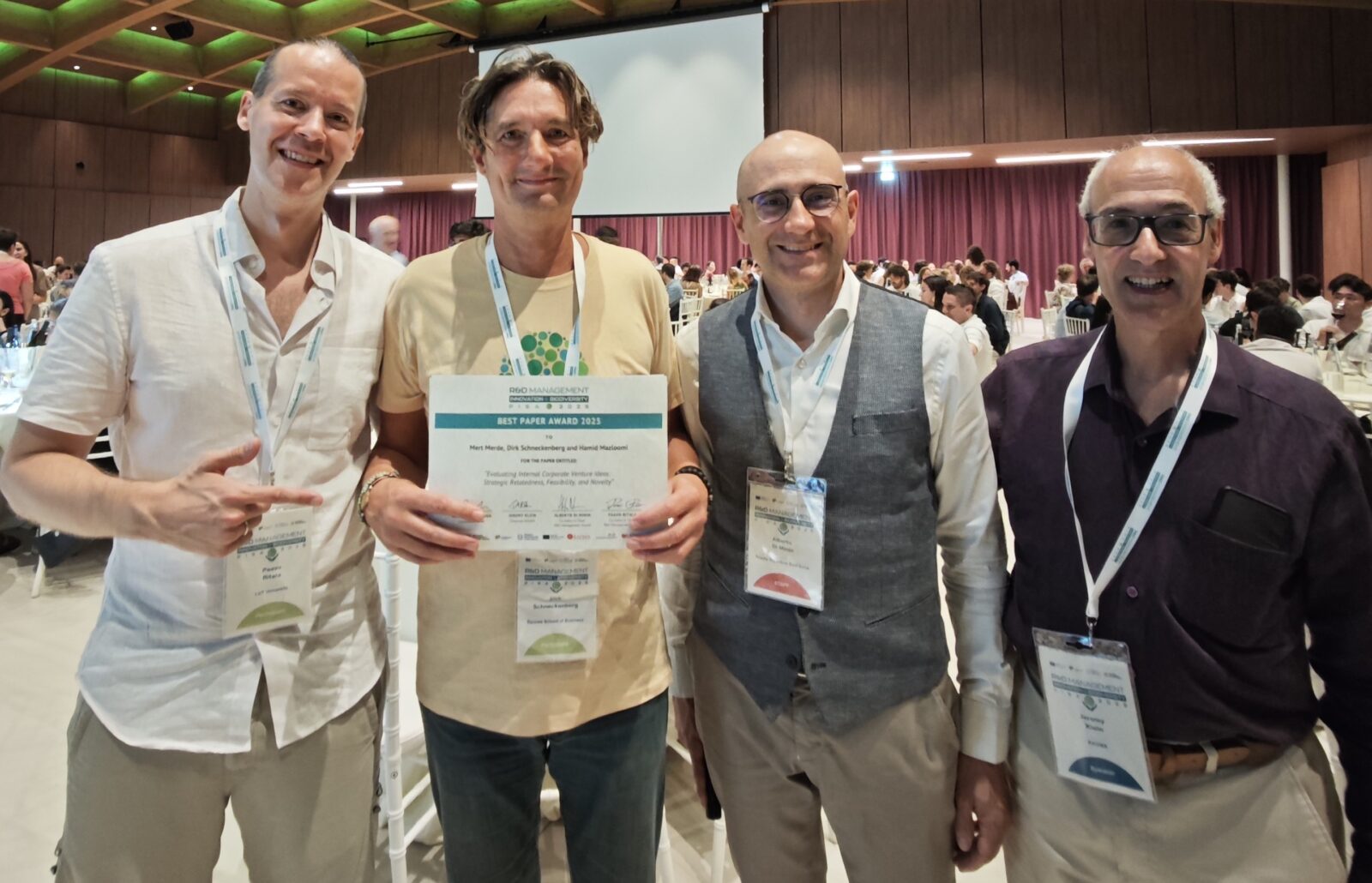
This was the subject of a study by Mert Merde, Dirk Schneckenberg and Hamid Mazloomi. Their paper entitled “Evaluating Internal Corporate Venture Ideas: Strategic Relatedness, Feasibility, and Novelty” gained the Best Paper award at the R&D Management Conference 2025.
We asked Mert about the study and the learning points.
Evaluating new ideas for strategic relatedness, feasibility, and novelty
Our study explores the factors influencing how internal corporate ventures (ICVs) select new business ideas, focusing on strategic relatedness, idea feasibility, and novelty.
Using a resource-based lens, we examined venture proposals within a multi-business firm to provide insights into internal selection dynamics in complex organisational contexts.
We found that:
- Synergy between the idea and business units is a key determinant. Ideas relevant to multiple business units are more likely to be selected than those with little or no alignment.
- Novelty, quality, and feasibility are also critical. ICVs tend to favour novel ideas directly connecting to the firm’s existing resources and capabilities.
- Clarity of direction matters. In dynamic environments, managers seek assurance about the intended trajectory of new ideas and how they fit within the broader strategic context.
Q: Do you think your findings are representative of all multi-business firms or specific to a particular industry?
A: While the study is grounded in a single organisational context, the variables and constructs were intentionally selected to be generalizable across industries. Therefore, the findings broadly apply to multi-business firms operating in diverse sectors.
Q: If strategic alignment with existing business unit resources is prioritized over broader corporate direction, is there a risk of ‘groupthink’? Could this limit innovation or diversification?
A: That is an important concern. Interestingly, our findings suggest that alignment does not limit innovation – on the contrary, it enables innovation.
By grounding new ideas in available capabilities, firms can pursue innovation with greater focus and feasibility.
Strategic alignment helps identify how novel directions can emerge in credible and scalable ways within the organisation’s portfolio.
Q: Was it easy for the Internal Corporate Ventures to gain visibility into the ideas being generated? Where did these ideas come from, and how was their value assessed?
A: Yes, idea visibility was established through structured processes.
Ideas were submitted from various levels of the organisation – either via web-based platforms or directly through email to dedicated innovation teams. The evaluation process included multiple stages, such as idea screening and selection by formal idea councils, which ensured that promising ideas received attention and consistent feedback.
Q: Some companies maintain ‘idea knowledge bases’ to keep track of past submissions and outcomes. Is this something you would recommend?
A: Absolutely. Capturing the history of all submitted ideas—including those not initially selected—provides long-term strategic value. Conditions evolve, and ideas that were once infeasible may become viable in the future.
A well-maintained knowledge base also helps prevent duplication and supports organisational learning by making past feedback and expertise visible.
About the authors
Mert Merde, Technology Solutions Leader, Borusan Makina ve Güç Sistemleri / Caterpillar.
Dirk Schneckenberg – Professor at Rennes School of Business
Hamid Mazloomi – Associate Professor at Rennes School of Business