While disruption poses strategic and operational challenges for organisations, it also creates new opportunities for value creation and transformation.
Within this context, creativity and resilience are essential capabilities: creativity drives novel solutions, while resilience enables adaptation and sustained innovation.
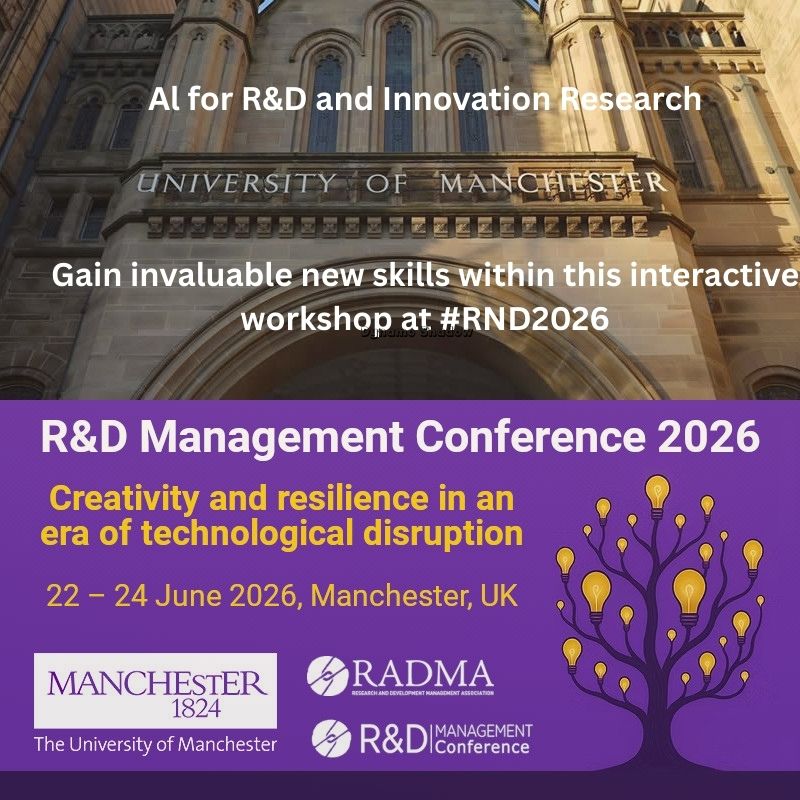
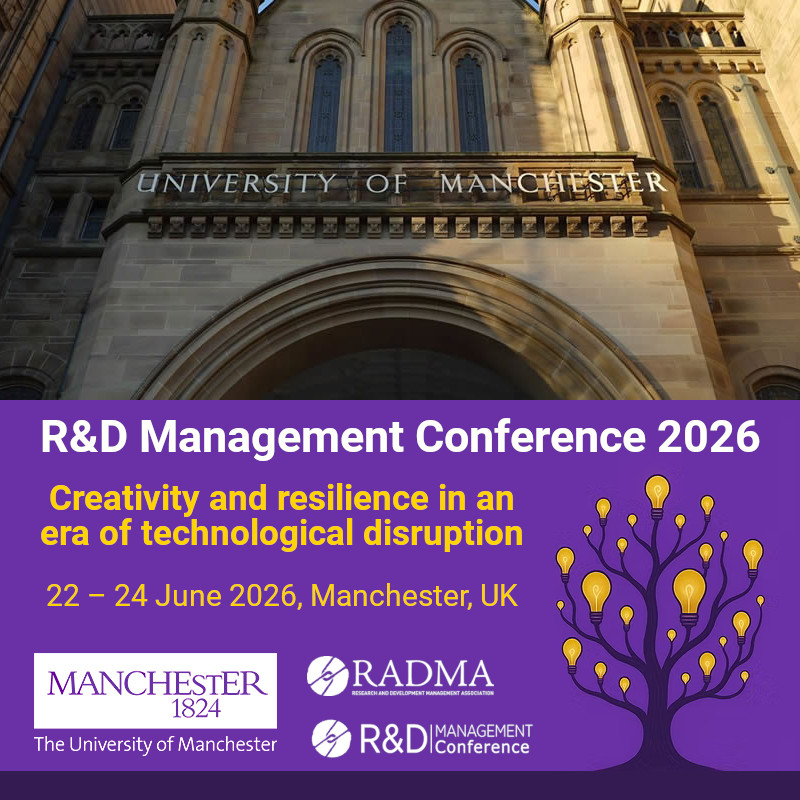
The R&D Management Conference 2026 examines how creativity and resilience can help navigate and embrace technological disruption.
Keynote speakers include



The R&D Management Conference offers a vibrant and thought‑provoking programme that brings together leading scholars, practitioners, policymakers, and innovators.
Centred around the University of Manchester, #RND2026 features an energising mix of plenary sessions, parallel tracks, networking events, and social gatherings designed to spark discussion and foster collaboration.
It includes:
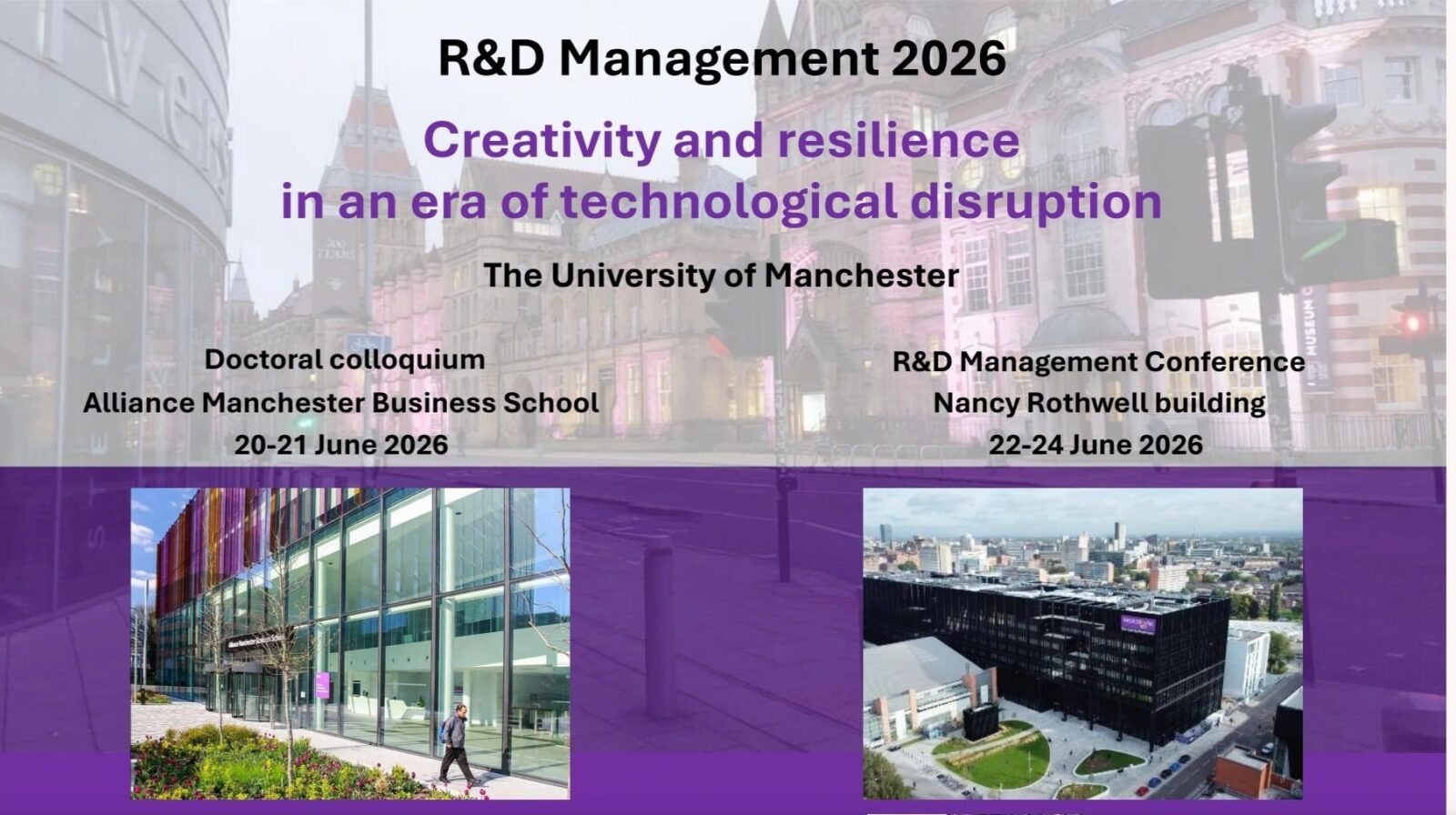
- Doctorial colloquium – 20-21st June
- Evening reception at the Manchester Museum – 21st June
- Conference begins with welcome speeches and the first plenary – 22nd June
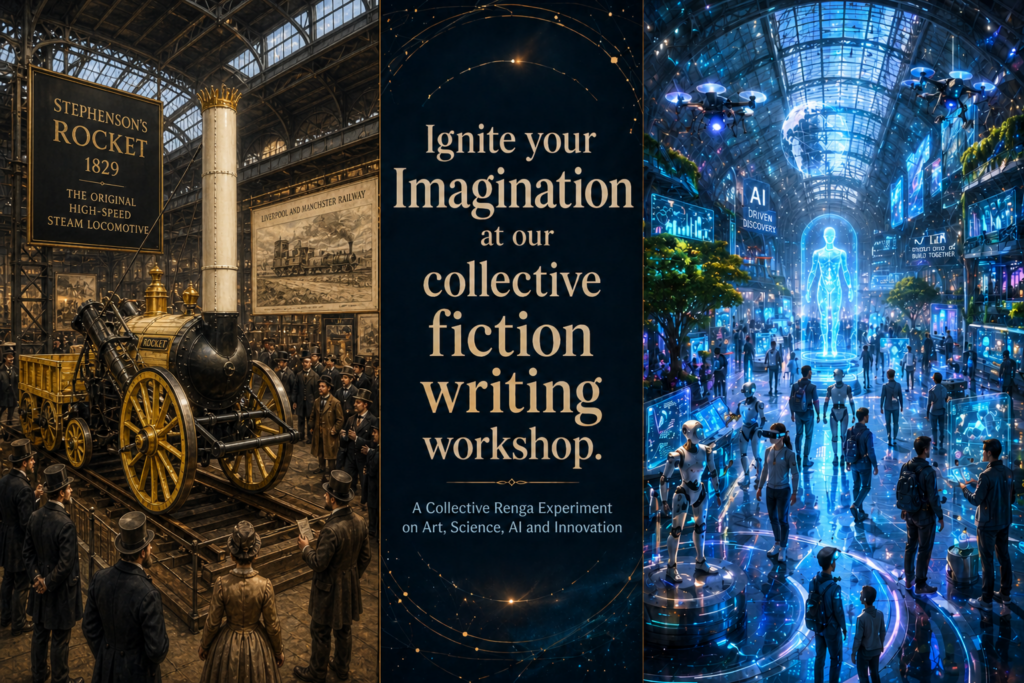
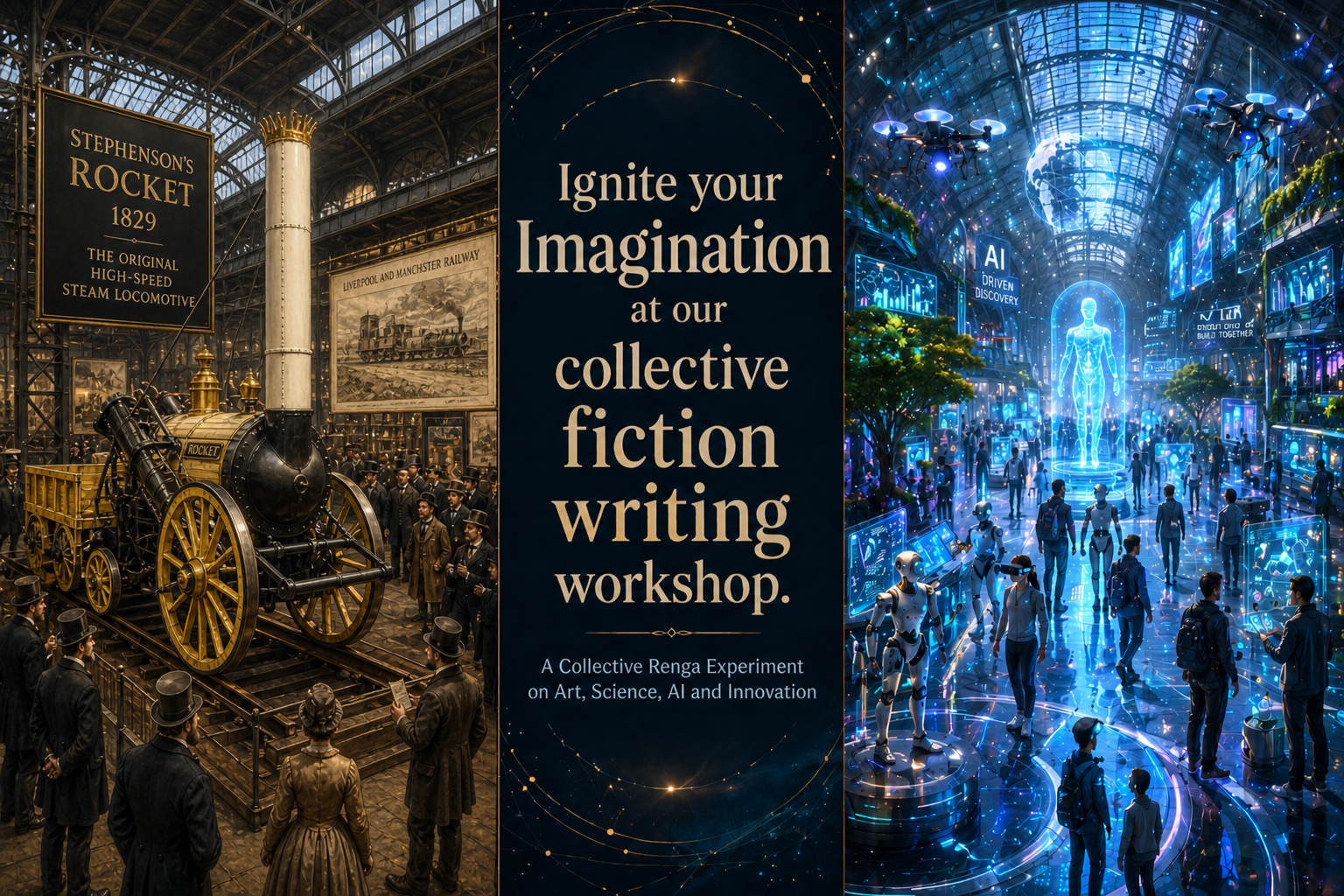
- Professional development workshops – AI in Action and Arts-Based Initiatives
- Networking at Whitworth Hall – 22nd June
- Gala Dinner at Victoria Warehouse – 23rd June
Registration closes on the 15th May and early reservation of accommodation is recommended.
Want to build your skills in research and innovation management with likeminded individuals? Join a professional development workshop – we have two during the conference.
R&D Management Conference 2026
The first R&D Management Conference was held in Manchester in 1980 and each year the conference has been organised by a different institution.
This year the conference returns to its birthplace and is organised by Manchester Institute of Innovation Research at Alliance Manchester Business School, and The University of Manchester.
R&D Management Conference 2026 tracks – (Click here for more information)
1.1. Unlocking the creativity and resilience of STEM researchers – Elicia Maine, Simon Fraser University
1.2. Managing generativity in innovation: from control to emergence – Antoine Bordas, Mines Paris
1.3. Creativity in digital innovation: designing beyond the code – Angel Jimenez-Aranda, University of Salford
1.4. Arts-based initiatives, creativity and innovation – Daria Podmetina, Taltech University
1.5. Fostering creativity and resilience under constraints – Bibhuti Ranjan Bhattacharjya, Indian Institute of Technology (IIT) Roorkee
1.6. The role of multidisciplinary as enabler of creativity and reslience in industrial digitalization – Vito Del Vecchio, University of Salento
1.7. Mind the gap: human-centred creativity and resilence in digital transformation and AI – Marie Griffiths, University of Salford
1.8. Eco-design, creativity, and digital innovation for resilient and sustainable product lifecycles Cristina Ledro University of Padova
1.9. Front end of Innovation: creativity in early-stage development – Stuart Grant, Cranfield University
1.10. Co-design for transitions – Alexandre Azoulay, Centre de Gestion Scientifique
2.1. Fostering creativity and resilience in the age of twin transition – Domenica Barile, University LUM Giuseppe De Gennaro
2.2. Business model and business model innovation – Patrick Spieth, University of Kassel
3.1. Understanding the crowds in technology and innovation management – Niharika Garud, University of Melbourne
3.2. Fostering creativity and resilience through corporate-startup collaborations – Elie Saad, Umea School of Business
3.3. Orchestrating Collaboration – Silvia Gadola, Politecnico di Milano
3.4. Community-led R&D and innovation processes – Nunzia Coco, University of Bologna
3.5. R&D infrastructure and university-industry collaborations – Khaleel Malik, University of Manchester
3.6. Purpose, implementation and innovation performance – Martina Tafuro, Sant’Anna School of Advanced Studies
4.1. AI-driven Innovation Ecosystems for SME Growth and Scale-up Keivan Aghasi University of Sheffield
4.2. Inside entrepreneurial ecosystems – Elena M. Gimenez Fernadez, Universidad Pablo de Olavide
4.3. Coopertition, ecosystems, networks and alliances (CENA) – Charlotte Chappert, University of Montpellier
4.4. Shaping nested ecosystems: understanding the mutual dynamics – Andrea Ancona, Università Cattaneo
4.5. Ecosystems as catalysts for sustinable and socially oriented technological innovation – Federico Bartolomucci, Politecnico di Milano
4.6. Networks, ecosystems and platforms for circular and regenerative innovation – Benito Mignacca, University of Cassino and Southern Lazio
4.7. Managing platform transitions: innovation pathways for incumbent firms – Alexander Engelmann, WU vienna University of Economics and Business
4.8. Harnessing human-AI synergy – Claudia Spilotro, LUM Giuseppe Degennaro University
4.9. AI and emerging technologies for social sustainability – Cristina Ledro, University of Padova
5.1. Creativity and resilience in global innovation systems – Dhruba Borah, University of Bristol Business School
5.2. R&D Management under geopolitical constraints – Andrew James, University of Manchester
5.3. Firms’ innovation responses to critical raw material dependence – Francesco Quatraro, University of Torino
6.1. Implementing AI in innovation processes – Diego Matricano, Università degli Studi della Campania
6.2. Innovating for climate resilience – Pelin Demirel, Imperial College
6.3. From adaptation to transformation – Valeria Maria Urbano, Economics and Industrial Engineering Politecnico di Milano
6.4. Technology-driven circular innovation – Jung Park, Pforzheim University
6.5. Innovation intermediaries and regional innovation systems – Guendalina Anzolin, University of Cambridge
6.6. Health technologies and disruptive change in medical innovation – Andrea Mina, Institute of Economics, Scuola Superiore Sant’Anna
6.7. Innovating with LLMs: the Roles of AI in knowledge extraction & generation – Vito Giordano, University of Pisa
6.8. Knowledge diffusion, transmission mechanisms and productivity – Raquel Ortega, Argiles University of Manchester
6.9. Innovation and policy in the age of disruption – Jacopo Cricchio, Piazza martiri della liberta
6.10. Governing innovation in turbulent times – Marian Garcia, Aston University
6.11 Shaping Responsible Innovation through Digital Technologies – Haiyan Lu, Newcastle University Business School
6.12. NPD in an uncertain world: emerging tools, methods, and approaches – Clio Dosi, University of Bologna
7.1. Intellectual property rights, drug regulation, and R&D investments in pharmaceutical innovation – Fabio Montobbio, Catholic University of the Sacred Heart
7.2. Intellectual property management: responsible and resilient IP strategies – Pratheeba Vimalnath, University of Exeter
8.1. Open Innovation: people, process, and performance – Francesa Capella, Sant’Anna School of advanced studies
8.2. Advances in AI to promote open innovation – Saverio Barabuffi, Scuola Superiore Sant’Ann
8.3. From Open Innovation to Intelligent Innovation – Beatrice Orlando, University of Ferrara
8.4. Rethinking openness: how AI is rewriting the rules of collaborative innovation – Mariangela Piazza, Universita degli Studi di Palermo
9.1. The mistaken AI: beyond the hype – Francesca Iandolo Sapienza, University of Rome
9.2. The technology dimension of R&D management – Jeremy Klein, RADMA and Technologia
9.3. AI in the Lab: transformations in R&D and the practice of science – Philip Shapira,University of Manchester
9.4. Strategic leadership in the age of AI: a multi-echelon perspective on top and middle managers’ dynamics – Simone Bevilacqua, University of Turin
9.5. Threat from within: tacking internal sabotage to foster R&D creativity, and organizational resilience – Elena Coli, University of Florence
9.6. Bridging scales of change – Diletta Pegoraro, University of Manchester
9.7. Rediscovering the importance of company case studies in R&D Management – Giovanni Tolin, Sant’Anna School of Advanced Studies
Conference Chair

Bringing the community together to share ideas
The R&D Management Conference is an international event, which brings together academics, managers and practitioners involved in R&D, technology and innovation management.
It is hosted by the Research and Development Management Association (RADMA) which is an independent charity that supports education, research and innovation in the field of R&D management. RADMA provides a number of grants for post-graduate students including support for a Colloquium at the conference.