In complex R&D environments, performance rarely hinges on the components alone. More often, it depends on the quality of the relationships between them, comments Abi Hird, founder of Defankle.
“Whether we are talking about an engineered system, blocks of code, scientific experiments, teams, or organisational objectives – misalignment, delay, duplication, and missed opportunity tend to arise not within individual units, but at the points where those units interact.”
In this guest post she introduces a simple tool – the N-Squared diagram – which uses a matrix to represent the functional and/or physical interfaces between elements of a system, and explains how it can be used for innovation exploration.

The value of connection
Innovation management is awash with frameworks. We have canvases for value propositions, funnels for technology readiness, stage-gate models for governance, and maps for customer journeys.
Most of these tools focus on things: products, functions, markets, processes. They ask us to define, refine, and optimise discrete components.
In fact, isn’t that just life in general?
We tend to focus on the individual entities and less on the connections between them. If you ask someone to draw a diagram, nine times out of every ten, they’ll put labels in the boxes and leave the arrows unlabelled.
N-squared diagram makes interactions visible
The N-squared diagram offers a simple but powerful way to make interactions visible.
Although commonly used in systems engineering to analyse interfaces within large-scale technical defence or space programmes, it remains surprisingly under-used in regular innovation management contexts.
Yet, the humble N-squared brings a phenomenal opportunity for better insight, because its logic aligns closely with the realities of contemporary R&D: interconnected ecosystems, regulatory entanglement, distributed decision-making, and collaborative value creation.
What is an N-squared diagram?
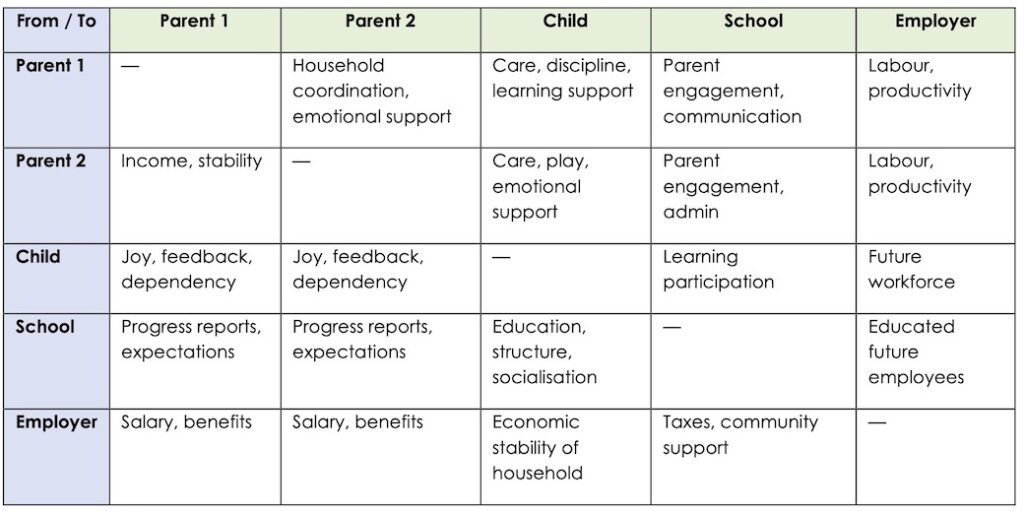
Despite its slightly technical name, the N-squared diagram is straightforward in structure. One begins by listing a set of actors or entities across the top of a square matrix. The same list is then repeated down the left-hand side. Each cell within the matrix represents what one actor provides to another.
If there are six actors, the result is a six-by-six grid. The “N” simply refers to the number of entities included.
The discipline lies in completing the cells with care. Rather than describing generic relationships, the exercise asks specifically: what flows from one to the other? This may include tangible exchanges such as materials, capital, or data, but it also encompasses less visible elements such as decision rights, influence, risk transfer, emotional labour, or reputational impact. A top tip: be explicit about the types of relationships you are modelling.
By forcing clarity about exchanges, the diagram shifts attention away from organisational boxes and towards the interfaces that connect them.
Why interfaces matter in R&D
Different stakeholders frequently hold divergent views of what they provide and what they receive. Making these differences visible in a structured format creates the conditions for redesign.
In complex R&D systems, it is rarely (never?) technical competence alone that determines success.
- Projects stall because information arrives too late or in immature form.
- Promising technologies fail to scale because regulatory insight is introduced at the wrong stage.
- Customers disengage because the value they experience does not match the value the organisation believes it is delivering.
These are not component failures; they are interface failures.
The N-squared diagram is powerful precisely because it makes these interface dynamics explicit. When completed collaboratively, it often reveals hidden dependencies, structural bottlenecks, and asymmetries in responsibility or influence.
Teams begin to see where value is assumed rather than designed, and where friction is embedded in the structure of interaction itself.
Importantly, the insight emerges not only from the completed matrix, but from the discussion required to build it.
Highlighting reciprocal value exchanges
One practical application is in mapping supply and partner ecosystems. Traditional supply chain maps tend to focus on material or process flows. An N-squared approach instead highlights reciprocal value exchanges.
Consider mapping actors such as installers, regulators, distributors, maintenance providers, internal technical teams, and end-of-life processors. By articulating what each provides to the others, organisations often discover that influence does not reside where it was assumed. A regulator may shape design decisions far earlier than anticipated. An installer’s practical constraints may determine perceived product quality more than formal specifications.
This reframing can alter innovation priorities. Rather than concentrating exclusively on product features, organisations may choose to innovate at the level of interface management, training, data sharing, or collaborative governance.
Diagnosing internal friction
The same logic applies within the organisation. When projects stall or decision-making feels opaque, an internal N-squared map can illuminate the problem.
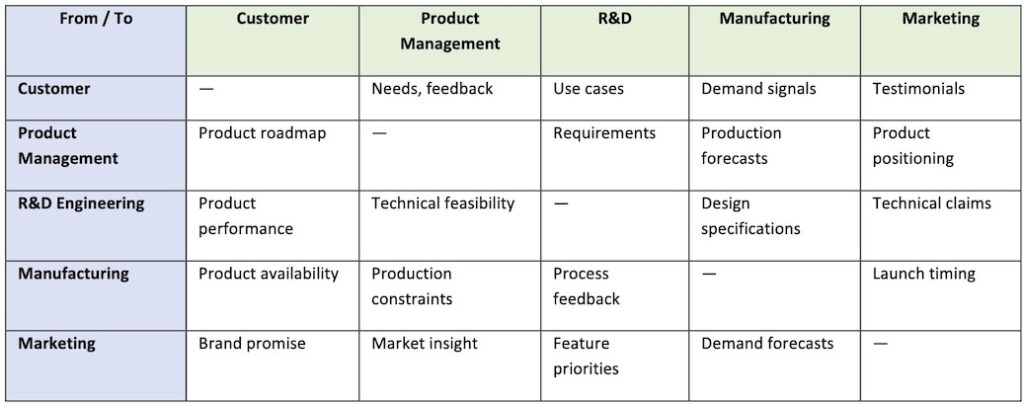
By listing key functions (R&D, product management, sales, operations, compliance, finance) and documenting what information, authority, and resources pass between them, patterns quickly emerge. Some exchanges may be mature and timely; others may be partial, duplicated, or informal. Colour coding or simple annotations can help visualise intensity and quality of exchange.
In many cases, what appears to be technical delay is revealed as structural misalignment. Innovation managers are then better positioned to intervene not by accelerating individual tasks, but by redesigning interaction points.
Understanding the customer’s lived experience
Perhaps the most generative use of the N-squared diagram is in understanding customer ecosystems. Instead of mapping the internal process, organisations can map the customer’s reality: the product, competitor offerings, workarounds, support services, and the customer’s own internal stakeholders.
When these actors are placed in a matrix and their exchanges documented, the organisation can ask a critical question: does what the customer actually receives align with what we believe we are providing?
The gap between intended value and experienced value often becomes visible. That gap represents a concrete opportunity for innovation; whether through redesign of the offering, better integration with complementary services, or improved communication of benefits.
Designing systems, not just pipelines
Modern R&D increasingly operates within complex socio-technical systems. Innovation managers are therefore not only overseeing pipelines of ideas; they are shaping networks of interaction. In this context, tools that foreground relationships rather than components are particularly valuable.
The N-squared diagram does not generate ideas in the conventional brainstorming sense. Instead, it clarifies the structure within which ideas must operate. By illuminating dependencies and misalignments, it enables more intentional system design.
In practice, a useful starting point is to select a bounded system (such as a product launch, a strategic partnership, or a specific customer segment) and identify a manageable number of key actors.
Building the matrix collaboratively and, where possible, comparing multiple perspectives of the same system can be especially revealing. The discrepancies between perceived and actual exchanges often point directly to areas of unrealised potential.
N-squared diagram reveals innovation at the intersections
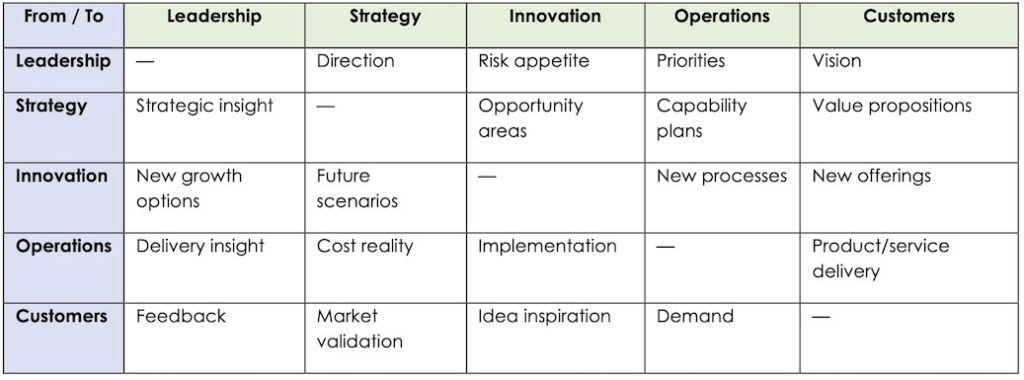
It is common to hear that innovation happens “at the intersections”. The N-squared diagram operationalises this idea. It directs attention to the spaces between actors, where value is co-created, distorted, delayed, or lost.
In R&D environments characterised by regulatory complexity, cross-functional collaboration, and ecosystem dependency, those spaces are rarely neutral. They are active, dynamic, and consequential.
By shifting focus from the boxes to the interfaces, innovation managers gain a more systemic perspective on performance. Sometimes the most transformative insights do not come from adding new components, but from redesigning the relationships that already exist.
The N-squared diagram is not a fashionable new framework. It is a disciplined, understated tool. But in an era of increasingly interconnected innovation systems, it may be precisely the perspective we need.
About the contributor
Dr Abi Hird is the founder and Director of Defankle Innovation Limited, an consultancy based in Scotland specialising in systems-led innovation, design, and technology for engineering firms.