“Industrial firms talk a lot about digital twins, connected assets, and smart products but many cyber-physical programmes stall because teams assume “integration” is a single pathway,” argues Marin Jovanovic. “In reality, there are two distinct playbooks with different implications for architecture, data, and governance.”
We asked Marin about cyber-physical integration through the lens of his Research Policy paper Platform design and governance in industrial markets: Charting the meta-organizational logic, and what it means for designing systems that actually learn and improve in the real world.

Cyber-physical integration is creating autonomous systems
Cyber-physical integration is the purposeful coupling of a physical system (a machine, vehicle, factory line, infrastructure asset) with a digital layer (sensing, software, connectivity, analytics, and/or simulation) so that each can improve the other.
It’s a big deal now because the digital layer is no longer only for monitoring, it is increasingly used to change how products are designed, operated, serviced, and upgraded across their lifecycle. The systems are increasingly autonomous.
The twist is that cyber-physical integration is happening in two different directions:
- Proactive integration: you add digital capabilities before you know exactly what the best use cases are, because you want to create option value and learn from real-world use.
- Retrospective integration: you use digital simulation/modeling to discover improvements that feed back into the physical design, making the next physical iteration better.
They can look similar from afar (“we have sensors and a twin”), but they require different design choices and different governance.
The aim of proactive integration is to ship a discovery platform
Proactive integration is “instrument now, discover later.” You embed sensing, compute, connectivity, and updatability into the product without assuming you already know the winning applications.
The design goal is not one perfect feature, but to ship a discovery platform that can:
- capture data with context – metadata, operating conditions, event definitions
- enable modular interfaces – capacity to add/replace sensors and capabilities
- secure update paths – OTA updates, rollback, traceability
- enable a learning loop – how data becomes decisions and product changes
Design to reveal the ‘killer app’
An example of practive integration could be where an industrial equipment maker (e.g., pumps/compressors) instruments a new product line with vibration + acoustic sensing, power-quality monitoring, and an edge gateway.
At launch, the team genuinely doesn’t know which value will dominate—predictive maintenance, energy optimisation, uptime guarantees, or compliance reporting.
In the first months of operation, patterns emerge in a specific segment (say, food processing): certain micro-events correlate with downstream quality problems. The “killer feature” becomes quality risk alerts, not the originally expected maintenance offer.
Proactive integration works here because the product was designed to surface the unknown.
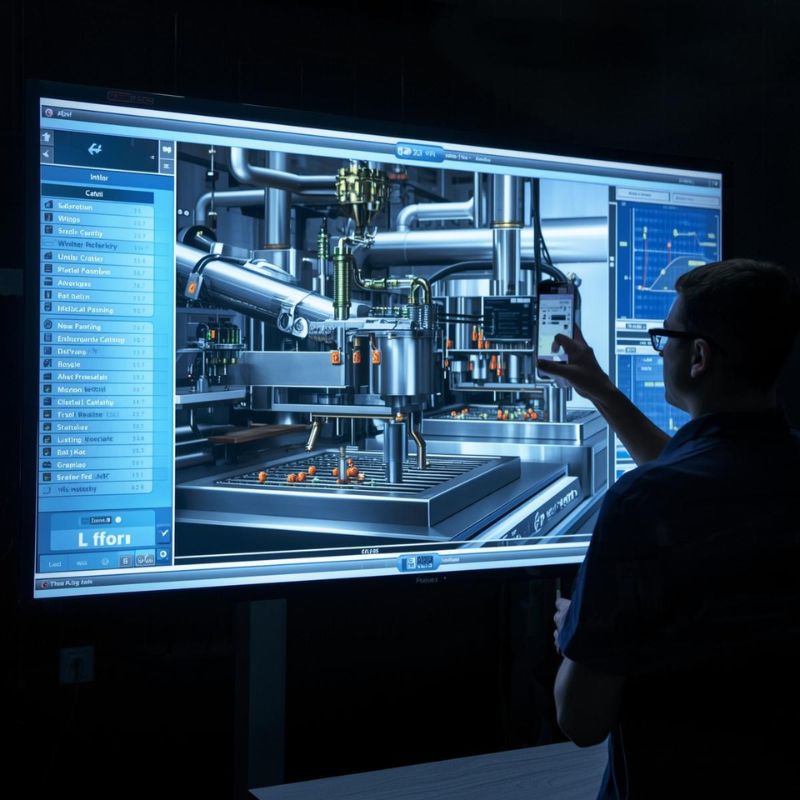
Retrospective integration is “simulate first, build better.”
For retrospective integration the digital layer — typically a simulation or twin — doesn’t just mirror the physical system. It becomes a design engine that proposes changes to geometry, materials, control strategies, thermal pathways, and interfaces.
The critical loop is: simulation insight → buildable design move → physical validation → model refinement.
Driver-in-the loop simulation provides validated changes in F1
Formula 1 teams use driver-in-the-loop simulators and digital twins to improve the car’s physical set-up.
They simulate alternative configurations, then calibrate the model with real on-track telemetry from a specific circuit.
The twin is used to test and recommend changes, ride height, suspension stiffness, wing angles, camber/toe, that can be implemented quickly.
The digital “feature” isn’t a dashboard; it’s a simulation-led learning loop that produces validated, actionable changes to the physical car.

Cyber-physical integration requires cross-actor governance
In industrial markets, cyber-physical integration rarely happens inside one firm. It spans OEMs, operators, suppliers, integrators, software vendors, and sometimes regulators.
Without credible cross-actor governance, proactive programmes generate “data exhaust,” and retrospective programmes produce models that nobody trusts or can operationalise.
That’s where the paper’s core point matters: platforms often behave like meta-organizations, coordination systems across independent actors.
For cyber-physical integration there is a need for governance to define:
- Who is allowed to access what data and at what granularity?
- Who can deploy updates to edge devices or control logic?
- Who certifies a third-party model, app, or algorithm that touches operations?
- Who carries liability if a digital change affects safety, uptime, or compliance?
What can go wrong when firms mix up the two playbooks?
The classic failure modes are different:
- Proactive failures: lots of sensors, little learning (poor metadata, unclear ownership, no decision pathways, no safe update mechanism).
- Retrospective failures: elegant models, weak reality (detached assumptions, poor calibration, insights that can’t be manufactured or maintained).
In both cases, the technical work may be strong but the integration logic and governance are mismatched.
How can managers avoid failure?
If value is unclear and uncertainty is high: go proactive, design for discovery and future option value.
If the bottleneck is known and physics-rich: go retrospective, use simulation to compress learning and drive redesign.
And the best programmes often sequence them: start proactive to expose what matters in the field, then shift into retrospective loops once the dominant constraints become visible.

Cyber-physical integration succeeds when leaders treat it as two distinct learning playbooks—proactive discovery and retrospective redesign—supported by platform governance that makes cross-firm data, updates, and accountability workable.
Read the paper:
Platform design and governance in industrial markets: Charting the meta-organizational logic, Virginia Springer, Krithika Randhawa, Marin Jovanović, Paavo Ritala, Frank T. Piller. Research Policy, Volume 54, Issue 6, July 2025, 105236