
Skip to content
Generic filters
Exact matches only
Search in title
Search in content
Search in excerpt
Filter by Article Type
Papers
Events
Tools
Funding Articles
Case Studies
Resources
Opportunities
Theme Editor Blogs
Filter by Categories
Business model innovation
Ideation and creativity in R&D
Latest news
Managing international R&D
Managing technology platforms
Managing the R&D pipeline
Open innovation
Outsourcing R&D
Project valuation and selection
R&D strategy
Roadmapping
Stage gate processes
Technology intelligence
  • Home
  • About
    • About R&D Today
    • Contributors
    • R&D Publications
    • R&D Today newsletter archive
  • Themes
    • Key R&D Themes
      • Rationale for key themes
      • Ideation and creativity in R&D
      • Managing international R&D
      • Managing the R&D pipeline
      • Open Innovation
      • Roadmapping
      • Technology Strategy
    • Deep Dive
      • Dynamic capabilities for strategic innovation
      • Would a ‘Strategy Lab’ provide sustainable renewal of competitive advantage?
      • Design Thinking
      • China’s new model for Open Innovation
      • Penetrating the fog of Agile
      • The resurgence of frugal innovation
      • Impact of digital technologies
    • Special Focus
      • The People Factor
      • Innovation for a Sustainable Future
      • How to measure the value created by innovation
    • Key Conference Tracks
      • Business model innovation
      • Entrepreneurial Ecosystems, Innovation Ecosystems and platforms
      • Intellectual Property Rights
      • Sustainable Innovation
    • Innovation Leadership
      • Innovation Manager job description
      • Best books for innovation management?
      • Must read papers on aspects of R&D Management
  • RADMA
    • About RADMA
    • R&D Project Exchange
    • Celebrating 40 Years of RADMA
    • RADMA Scholars
    • R&D Management Journal
  • The Pentathlon Framework
    • Strategy
    • Ideas
    • Selection & Prioritisation
    • Implementation
    • People & Organisations
  • Knowledge Hub
  • R&D Management Conference
  • Events
    • Upcoming events
    • Events Archive
  • Contact
  • Home
  • About
    • About R&D Today
    • Contributors
    • R&D Publications
    • R&D Today newsletter archive
  • Themes
    • Key R&D Themes
      • Rationale for key themes
      • Ideation and creativity in R&D
      • Managing international R&D
      • Managing the R&D pipeline
      • Open Innovation
      • Roadmapping
      • Technology Strategy
    • Deep Dive
      • Dynamic capabilities for strategic innovation
      • Would a ‘Strategy Lab’ provide sustainable renewal of competitive advantage?
      • Design Thinking
      • China’s new model for Open Innovation
      • Penetrating the fog of Agile
      • The resurgence of frugal innovation
      • Impact of digital technologies
    • Special Focus
      • The People Factor
      • Innovation for a Sustainable Future
      • How to measure the value created by innovation
    • Key Conference Tracks
      • Business model innovation
      • Entrepreneurial Ecosystems, Innovation Ecosystems and platforms
      • Intellectual Property Rights
      • Sustainable Innovation
    • Innovation Leadership
      • Innovation Manager job description
      • Best books for innovation management?
      • Must read papers on aspects of R&D Management
  • RADMA
    • About RADMA
    • R&D Project Exchange
    • Celebrating 40 Years of RADMA
    • RADMA Scholars
    • R&D Management Journal
  • The Pentathlon Framework
    • Strategy
    • Ideas
    • Selection & Prioritisation
    • Implementation
    • People & Organisations
  • Knowledge Hub
  • R&D Management Conference
  • Events
    • Upcoming events
    • Events Archive
  • Contact

Menu

Domains of innovation intent

Innovation is not always customer led – many major breakthrough offerings originate in a lab, or spring from the imagination of a problem solver. So how can a firm exploit a market that does not currently exist?

This is the research interest of Gina O’Connor, of Babson College. She followed a number of large, established companies over 25 years to observe how they manage breakthrough innovation.

She found that removing all restrictions does not foster innovation, instead having a structure and “guard rails can unleash creative responses”.

One of the translatable concepts she developed was that of “Domains of  Innovation Intent” – essentially stories about the future and how the company can play a role.  These domains can contain a portfolio of opportunities or projects.

Domains of Innovation Intent

Gina comments that although senior leaders want breakthrough innovations, they often fail to guide the direction of those strategic ambition areas.

By articulating and committing to Domains of Innovation Intent – that align innovation with a vision of the company’s future – leaders are compelled to commit to building a capability for breakthrough innovation.

In her paper, Gina observes a pivotal moment at IBM, when the CEO Lou Gerstner exploded with frustration when he realised the company had missed the emerging bioinfomatics market.  The root cause analysis found that senior leadership was prioritising today’s issues over those of the future, the spilt was 95/5.

As a result their time and resources were reallocated with at least a third to be spent on “Emerging Business Opportunities” to maintain competitive advantage.

Three phases of research over 25 years

The challenge – The first phase of the project followed twelve potential breakthrough projects, in ten companies over five years. This project articulated the challenges given the high degree of market and technical uncertainity and how they tried to resolve them.

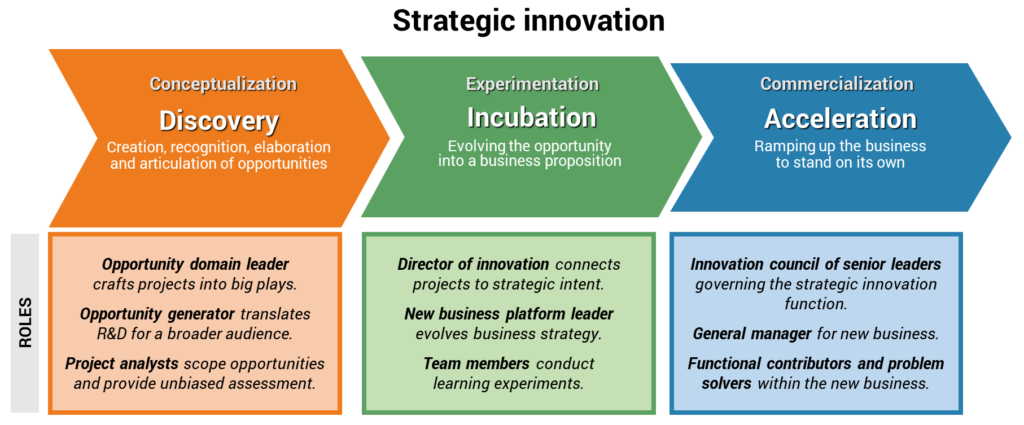
Organisational competencies – The second phase looked at the management system used to create repeatable innovation, rather than adhoc, serendipitous events.  This identified three distinct organisational competencies – Discovery, Incubation and Acceleration – and the challenge of talent management.

Discovery can be thought of as the business concept development phase. Incubation turns the concept into a business proposal. Acceleration is the competency of scaling the emerging business as it moves towards the market. Together these competencies lay the foundation for strategic innovation and breakthrough innovation.

Innovation framework – The third phase identified the roles and responsibilities required for each competency, the challenges in an individual’s career path and offered a framework that could be used to formalise the innovation function. Gina identifies 9 roles.

Only once these systems are in place can companies achieve true strategic innovation on a sustained basis.
Domains of intent

Read the paper

Domains of innovation intent: A key leadership responsibility

Also Beyond the Champion: Institutionalizing Innovation Through People, Babson Professors Gina O’Connor and Andrew Corbett identify nine key roles that businesses must fill to achieve strategic innovation—a must in today’s business world.

Gina O’Connor’s book draws on the results of a four-year study. She combines that with decades of additional academic research, hundreds of interviews with corporate innovators, and ongoing consulting to help companies build the capability. Her work has influenced the ISO 9000’s guidance on innovation, and is taught on numerous campuses worldwide.

  • 18 April 2024
View our newsletter archive
  • Related posts

    • How can established companies resource radical innovation?
    • How can we empower our R&D teams to create new opportunities?
    • Is innovation management a profession? And should it be?
  • Have your say

    Have your say / Follow us

    Linkedin Soundcloud Twitter Youtube Linkedin-in

    R&D Today is the outreach site for the Research and Development Management Association, a charitable organisation that supports research, best practice and innovation.  www.radma.net

    Click here to sign up to our newsletter, and
     click here to view our newsletter archive.

    © Copyright R&D Today

    2026.

    All rights reserved.