Although widely accepted that radical innovation is crucial driver for a firm’s rejuvenation, innovation managers often struggle to access the resources required from the mainstream business.
In their paper “Resourcing Radical Innovation: Leveraging from the mainstream to create the newstream” Mario Sergio Salerno, Ana Paula Paes Leme Barbosa, Tiago Paz Lasmar and Gina O’Connor, studied one Brazilian owned multinational that within years created new business streams that reinvigorated the company’s fortunes.
Tension between mainstream and newstream
Radical innovation requires a different management approach to that of the core business, where increasing efficiency is often the main objective. This difference in focus creates a tension between the two management styles.
In particular, mainstream’s emphasis on a clear plan introduces a rigidity that can challenge the more fluid approach that radical innovation project require. Furthermore, innovation managers can have their careers penalised if they are evaluated by the same criteria as mainstream product managers.
To resource radical innovation requires a tailored management system
So, if the future of the company is dependent on radical innovation, then a fundamental question arises: How can managerial systems overcome rigid processes and prioritise resources for RI project, while mitigating risk of the unknown?
Research by Mario Sergio Salerno and colleagues found that that change in the managerial system is needed to sufficiently resource radical innovation.
Mario explains: “Although it is widely accepted that culture and leadership have a vital role, it is often overlooked that both run on a structural basis – the managerial system.
“We would argue that radical innovation requires a tailored managerial system designed to facilitate access to mainstream organizational resources in order to support RI projects.”
Over a twelve-year period, they studied an organisation in transition and showed how it created a management system that successfully allocated resources for radical innovation and integrated the existing and new businesses to ensure the most effective use of resources.
Case study: MAIN
MAIN is a worldwide leader in the design and production of complex high-tech transport systems. It is headquartered in Brazil with facilities in Europe, Asia, North and South Americas. It employs about 20,000 people, of whom 5000 are in R&D and engineering and 380 in research.
The main business is built on proprietary technology that requires significant financial investment. Despite iterative product development its income had stagnated, and the competition was increasing. It became apparent to a small group of middle and senior managers that strategic innovation was essential for achieving growth.
Previous attempts to develop radical innovation within the company had failed as the mainstream organization effectively suppressed every project. So it was clear that a different approach was required.
In 2017 they raised their concerns with the CEO and highlighted several radical innovation projects that they had identified that would have game changing potential. After much discussion the senior leadership agreed and launched a new company INCUB to incubate the newstream projects.
Confidential – note
Unfortunately, the researchers were not able to use the real name of the organisation they studied, so have used the following code names:
• MAIN – the established company
• INCUB – a new company set up to incubate RI projects
• ACCEL – a new company for detailed engineering design and commercialisation
They also use ‘mainstream’ to identify existing business and ‘newstream’ for radical innovation projects.
Outcomes
INCUB announced 3 projects, each in a nascent market. Within 15 months they had matured sufficiently for the senior management to call them successful and initial revenues start to flow.
Building on this success the company launched a further company ACCEL, dedicated to accelerating and commercialising projects and within 18 months its market capitalisation equalled that of MAIN.
So, what was the secret of this success?
The company had a three-step process, that engaged the support of senior leadership:
- Evangelization – the company had created an R&D department in the 1990s to explore emerging technologies but this was in truth aimed at continuous improvement. Taking advantage of the strategic threat the innovation manager took a group of senior managers to innovation hotspots worldwide to show them the opportunity.
- Structural ambidexterity – the senior management set up an initiative to fund promising new ideas (discovery) and created a new entity (INCUB) with 20 staff mostly project managers. The product development was by MAIN’s engineering department.
- Evidence based – once MAIN’s Innovation Strategic Directorate identified the technological possibilities for generating new businesses, the company established ACCEL.
Overcoming the obstacles with purposeful integration
The strategic threat combined with the evangelization, which identified the potential for organic growth through innovation, created a positive influence for culture change.
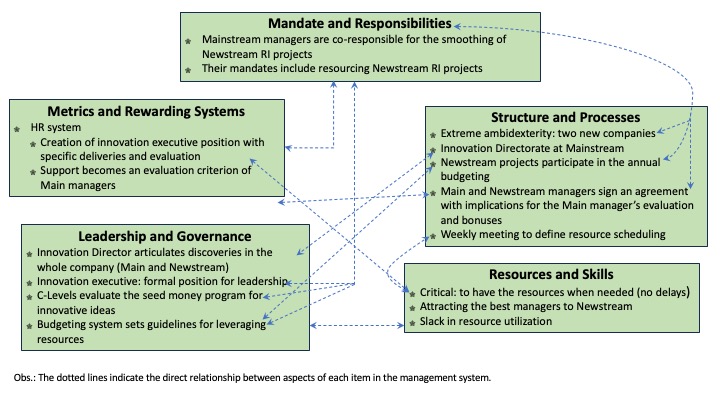
This was embedded into the organisation with a number of initiatives supported by the senior leadership to resource radical innovation.
- Release of resources – there was some slack in the system, so agreements enabled the new company to use mainstream laboratories.
- Budget allocation aligned to strategic objectives – resource allocation for INCUB was agreed at a senior level and every mainstream functional manager agreed to provide resources. Cooperation was written into their appraisals and bonuses. The budgeting process established a framework with weekly meetings, rules and enforcement that enabled alignment with the vision.
- HR system fosters engagement – HR processes and policies were designed to foster strategic innovation. This included an evaluation and reward system with criteria appropriate for radical innovation, plus the creation of a new role “innovation executive”. This was less task orientated and more entrepreneurial.
- Creation of new companies – it was recognised that radical innovation would not happen within the existing business units. Creation of the companies sent a strong message regarding commitment to the strategy.
- Leadership with strong reputation – new positions were created in both MAIN and the new companies for experienced MAIN managers with a mindset suited to newstream activities.
- Culture of innovation – the MAIN corporation had a culture of valuing engineering challenges and people at MAIN found the INCUB projects exciting and promising. Supporting the projects with sufficient resources created a forward-looking innovative culture.
In conclusion – how to resource radical innovation
“Our research offers deep insights into how to design strategies that enhance resource leveraging for radical innovation,” comments Mario Sergio Salerno.
“In particular, it emphasizes the need for a visible commitment to structural ambidexterity from senior leadership.”
To read the full paper
Salerno, Mario Sergio & Paes Leme Barbosa, Ana & Lasmar, Tiago & O’Connor, Gina. (2024)”Resourcing Radical Innovation Leveraging from the mainstream to create the newstream”. Technovation. 139. 103126. 10.1016/j.technovation.2024.103126.




Some useful references