
R&D Management Special Issue
R&D Management published a special edition on business model innovation, including a special editorial piece alongside five related papers which together form a comprehensive analysis of business model innovation.

R&D Management published a special edition on business model innovation, including a special editorial piece alongside five related papers which together form a comprehensive analysis of business model innovation.

nalogies are a useful tool for creative problem solving, to help one move away from the obvious and to encourage ‘out of the box’ thinking. Professor John Bessant shares his views on this interesting tool.

Today’s business reality is not based on pure open innovation but on companies that invest simultaneously in closed as well as open innovation activities.
Too much openness can negatively impact companies’ long-term innovation success, because it could lead to loss of control and core competences. Moreover, a closed innovation approach does not serve the increasing demands of shorter innovation cycles and reduced time to market.

A new approach has been developed at the University of Cambridge Institute for Manufacturing (IfM) to help companies assess how good they are at managing innovation and new technologies.
The development of successful new products and services is critical for profitable, sustainable growth. Investing in new technology is often essential but represents a significant challenge in today’s globalised and rapidly changing markets.
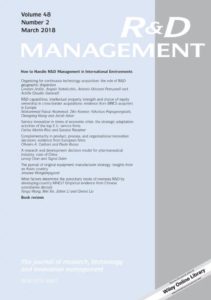
R & D Management publishes articles which address the interests of both practising managers and academic researchers in R & D and innovation management. Covering the full range of topics in research, development, design and innovation, and related strategic and human resource issues – from exploratory science to commercial exploitation – articles also examine social, economic and environmental implications.

The term “Hydrogen Economy” refers to a proposed system of delivering energy using hydrogen as thermal and/or electrochemical fuel. It will become sustainable when electricity generated from renewable energy sources is stored as hydrogen. The three key elements will be: production, storage and utilization of hydrogen as an energy carrier. The challenge is how can organisations exploit its potential.

Predicting the future is something that all companies find hard, especially part of that future could involve radical change. Nonetheless, companies are constantly expected to make the right bets on their technology portfolio, identifying future innovations that will make their products and services not only competitive but winners in a global marketplace. Often, the executive dialogue required in order to make these choices stalls, principally because there is no mechanism to create a bridge between ‘commercial strategic intent’ and what might be possible technically both in the near future and the longer term. How can forward-looking companies make the right investment choices?

The following have received RADMA support for their studies.
The Doctoral Studies call for applications opens 1st November 2015 and closes 29th February 2016. This award provides up to three years funding to prospective or mid-study PhD students attending a UK university.
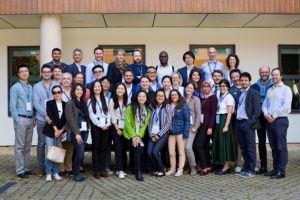
RADMA has issued an open call for proposals under its Postgraduate Project Support Programme.
The award provides support to talented mid-study Masters and PhD students.
Funding is for expenses directly related to their postgraduate research in the field of R&D management.
Up to £500 is available for Masters and £1000 for PhD projects.

RADMA helps fund students to attend the R&D Management Conference. The award provides support to talented mid-study Masters and PhD students who are presenting a paper at the R&D Management