Open innovation challenges are a way to solve the hardest problems on Earth (and beyond) by bringing together people from around the world, explains Trisha Epp, Director of Innovation for Freelancer International.
“What drew me to this work is that I love being a node in the network; connecting with the smartest, most insightful people who think deeply about diverse fields. I love learning about the cutting edge and biggest problems in every field.”
Freelancer.com is the world’s largest freelancing and crowdsourcing market place, it is used by organisations, including NASA to find breakthrough solutions to intractable challenges.
We asked Trisha about the benefits of using crowdsourcing for innovation.

Accessing talent
Although companies may aspire to hire the A+ players in their field and to build a high functioning team, they cannot hire unlimited talent – it is not possible to have an R&D team made up of every brilliant mind in the world.
Aside from budgetary limitations, there is also an optimal team size before you have different departments who are unaware of what each other are doing.
So there are several approaches to ideation and these may include: –
- Behind closed doors – you hire a team of the top talent, keep your trade secrets close, and create the top new products for the market. Best practices include design thinking and agile methodology. But with an inhouse team you run the risk of group think or relying on domain knowledge to solve problems.
- Market research and customer insights – a specialist consultancy can comb the market for what innovations are already out there that suit the problem, or they identify a market gap. However, relying on market analysis will not come up with new ideas which haven’t been tried yet.
Open Innovation offers an alternative approach.
Open Innovation challenges offer a third way
Open innovation challenges allow companies to crowdsource ideas from people around the world. With a limited budget, they can reach other experts in the field looking to make a name for themselves or to solve an interesting problem.
Traditional brainstorming can create a closed funnel that stops at the boundary of the organization, as the first idea said out loud can limit the creativeness of the rest, pegging the solution in a certain area.
This is not an issue for an Open Innovation challenge. The solvers do not know the ideas of the other participants, so they offer unique, out of the box ideas from their unique skills, perspectives, and culture.
Solvers participate for gold, guts, glory, and good
These competition-style events, enable individuals, teams, or companies to participate, and offer diversity by opening up the opportunity to retirees, up-and-coming students, or cross-industry experts in different geographies, all with a range of different perspectives.
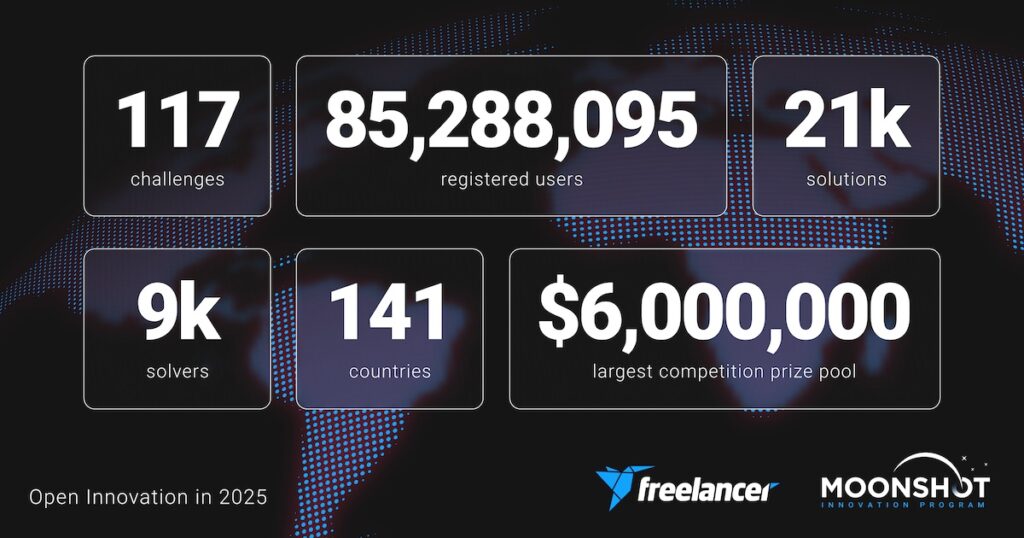
Participants come from all over the world. Freelancer’s community spans 85 million users at the time of writing, from 247 countries, regions, and territories.
Accessing people beyond the payroll
Sometimes the solvers are recognized experts at the top of the field of the target problem.
For example the NIH TARGETED Challenge was a $6M competition to encourage genome editing technology development and improved editing efficiency. Somatic cell genome editing holds great promise in treating various diseases. However, current techniques in genome editing approaches, such as those based on CRISPR-Cas9, pose many obstacles that need to be overcome before they can be widely used in the clinic.
The challenge attracted researchers from MIT, Yale, and biotech companies. One of the fourteen solutions selected was a team from the University of Maryland School of Medicine who won a $250,000 prize from the National Institutes of Health (NIH). They successfully demonstrated a new technique to deliver genome editing biotechnology across the blood-brain barrier in preclinical models.
The industry calls the motivations for competing the 4 G’s – gold, guts, glory, and good. With prize pools up for $6M, there can be significant financial incentives for winning.
On the other hand, a student or dilettante curious about the field can suggest an idea to see how they rank up. Some want to have the pride of being the best, while others are focused on the new technology that makes the world a better place. The reality is often a mix of motivators.

Humanity (our humanness) is what matters most in the existential and innovative scheme of things
Increasingly AI is being used as a tool for ideation, but Trisha says people are still better.
First of all, when someone puts the challenge brief into an AI LLM, it is obvious. Multiple people will do this and then we get duplicates with nearly the same response. They aren’t very good. AI models are trained on available data. However, not all information gets published in a publicly available manner.
Years of on-the-job training help practitioners develop intuition about ideas that just might work. On the other hand, this can also cause experts to have a feasibility bias that has been called anti-novelty.
Yet the research still shows that compared to AI, “human outputs were rated as more innovative, including extreme outcomes at the right tail of the novelty distribution”.
AI is also biased to English-language content, although projects are underway to expand its language training.
What humans still bring to the hardest problems is true expertise, rather than buzzwords, inflated importance, and hallucination errors.
Setting the open innovation challenge – first define the problem
Problem formulation is critical to ensure the problem holder gets the best solution.
Problem analysis ensures you are focusing on the root cause, not a symptom. The problem is decomposed and decontextualized stripped of company- or industry-specific details.
The result of this is two-fold:
First, the problem holder company protects their competitive advantage by keeping confidential critical information.
Second, by decontextualizing a problem, solvers from other industries are able to look at it and see something familiar, uninhibited by industry jargon.
The challenge design process produces a challenge brief, which includes the problem which needs to be solved, context needed, and criteria for the solution.
Open Innovation challenges are widely applicable
The technology arising from innovation challenges varies widely.
Recent examples include:
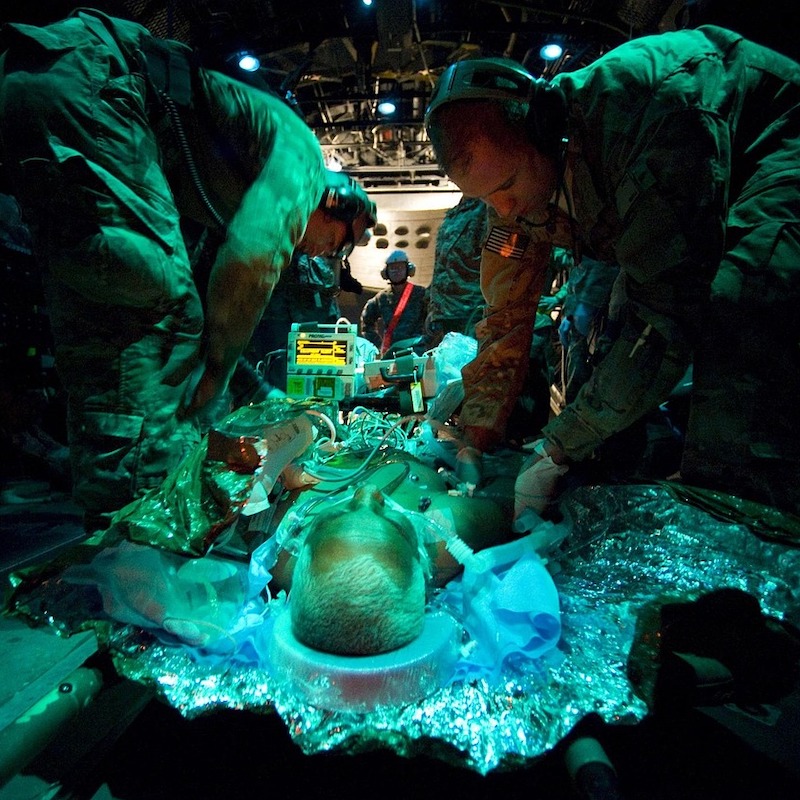
- augmented reality emergency response dashboards
- targeted genome editing medicine for rare diseases
- water protection through automated maintenances of hydroelectric dams
- tracking the journey to overdose from EMS data using network science
- remediating space debris in low earth orbit.
Moon Mascot for Artemis II
One idea that got me really excited was using acoustics – sound waves – to help with refueling spacecraft in microgravity. It was an out-of-the-box idea to solve a retrofit problem for long duration space exploration.
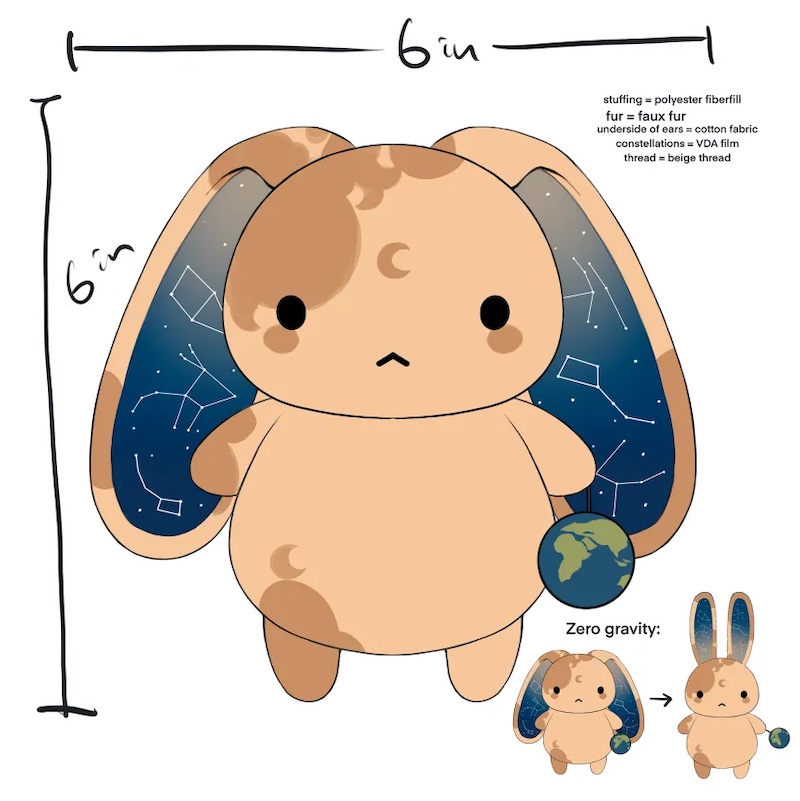
With NASA’s upcoming Artemis II mission, returning to the moon, the world was invited to help design the Moon Mascot, a zero gravity indicator (ZGI).
Zero gravity indicators are small items carried aboard spacecraft that provide a visual indicator for when a spacecraft has reached the weightlessness of microgravity. Thousands of participants of all ages from around the world submitted designs in hopes of resonating and inspiring the global community. NASA’s Thermal Blanket Lab will fabricate the winning design and send it on the next mission.
Democratizing access to solving big problems
NASA has specific requirements for employment that most people in the world don’t meet. By opening up innovation challenges, NASA invites global participation in space exploration. Millions of people are inspired to explore the cosmos.
One high school student has expressed that winning a competition in space engineering has opened up the field for him. He has travelled the world, speaking in front of top brass from NASA, ESA and others, following his success in the Freelancer ‘Rover Design Contest’.
Other participants have found their success lead to job offers, media accolades for their company, and resume boosters that their design for NASA won an international competition.
For all organizations, there are limits to the experts within your walls, including team size and budget. Or, you may have a need for a specific expertise but not as a full-time role. The open innovation approach unlocks something special by bringing together otherwise unlikely participants and perspectives to your process, making the end solution more accessible and diverse.
Practical advice for open innovation challenges
If you are reading this and thinking you want to try open innovation challenges, here’s some advice.
1. Identify a problem that your organization is facing.
The best types of problem are those that are either:
a. Highly challenging technical, analytical, or scientific
b. Requiring design, creativity, or aesthetic.
2. A comprehensive brief is key
What makes challenges succeed is the challenge design that breaks down the complex challenge into solvable components. Work with a challenge designer to craft a comprehensive brief that attracts the right talent and drives innovative solutions.
3. Engage with experts
A big mistake organizations make is trying to do everything themselves. It seems easy to just put up a submission email to bring in ideas, but there’s more to an innovation challenge than that, including crowd curation of solvers.
Helping to solve the greatest challenges
Imagine being able to harness millions of people to move our technology forward in service of humanity. The ability to look at a problem in one industry, and recognize the solution is already realized in another industry.
Whether we are building technology for space exploration, new genomic medicine for rare diseases, or making leaps forward in water protection, bringing global genius to the table helps solve humanity’s greatest challenges.
About the author
Trisha Epp is a Canadian innovation strategist who leads space and science open innovation challenges for NASA, NIH, and other international institutions.
Trisha is Director of Innovation for NASA Tournament Lab at Freelancer.com, the world’s largest freelancing and crowdsourcing marketplace.