Open Innovation is an approach that enables organisations to benefit from the expertise and knowledge of people from outside their organisation. In this guest post Nicola Doppio, Open Innovation Officer, Hub Innovazione Trentino(HIT) explains how the Hub Innovazione Trentino (HIT) is using Open Innovation to support its ecosystem and how it uses an Innovation Challenge Design Canvas.
HIT a non-profit foundation whose mission is to foster technology and knowledge transfer between research and business in the Trentino province (Italy).
Innovation challenges to co-develop solutions
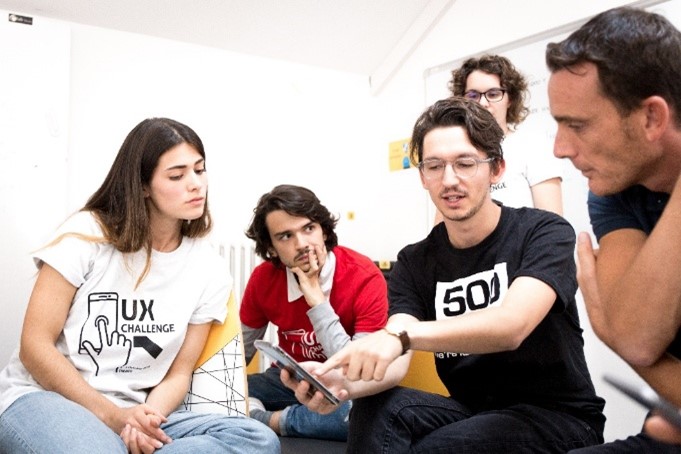
HIT organizes Innovation Contests (or Innovation Challenges) that allow companies and public administrations to co-develop solutions to technological innovation problems together with groups of university students, researchers, and startups.
HIT’s Innovation Challenges are essentially thematic open innovation programs held annually and focused on specific technological domains, for example: AI solutions for manufacturing companies, or for public administration; mechanical design for additive manufacturing; design of GUI – graphical user interfaces and digital interactions; biotechnology…). Multiple companies participate simultaneously, and each is assigned a team of young talents (solvers), selected and trained by HIT and supported by experts.
Prototype solutions in 3 months
During the Challenge, the solver team works closely with company staff to thoroughly investigate the problem and produce a prototype solution (not just ideas), such as machine learning-based predictive models and related code and improved datasets on GitHub, mockups and prototypes of GUIs, or optimized 3D CAD designs.
The results are delivered in a short time frame (maximum three months), and companies—who pay a participation fee—have the right to fully exploit the outputs (IPR of results belongs to the companies by regulation).
Case-study: Innovation Challenge Design solution could save Niris 4% of annual energy bill
One successful case is that of Niris, an Italian SME that develops IT solutions managing sensor data involved in the operations of wastewater treatment plants.
Niris participated as knowledge seeker in the Industrial AI Challenge, that aims to support knowledge seekers in developing AI and machine learning-based PoC and prototype solutions.
The problem proposed by Niris referred to the development of a machine learning model to predict the freshwater inflow to a water treatment plant, which impacts on the performance of the water treatment process and on energy consumption.
Niris made available a 20-year time series to solvers, and, as a result, solvers developed a predictive model that could allow up to 4% of annual energy savings in a water treatment plant.
Soon after the end of the contest, one of the solvers (a recent PhD graduate) was hired by Niris as R&D manager, while the other team members were contracted temporarily to further develop and industrialize the developed solution. In the subsequent months, the implemented solution was presented to a large client (a public administration) and, according to Niris, that contributed to obtaining an 8-year service contract.
Support of academic mentors game-changing
Going back to the contest setup, it’s worth noticing that, thanks to its position in the ecosystem, HIT can count on the support of university professors and researchers during both the set up and the execution of a Challenge—for example, by having direct access to university classes for recruiting purposes, and, what’s most, by involving academic staff as team mentors.
The role of the research mentor is crucial not only because mentors provide scientific supervision to the teams (which are usually self-organized and monitored by HIT during the Challenge execution), but also because they can play a key role in the follow-up.
In fact, companies often stay in touch with mentors after the Challenge ends in order to iterate on results (e.g., further development or validation), or to explore new collaboration opportunities.
Innovation Challenge Design Canvas
Over time, HIT has developed strong expertise in designing and launching Innovation Contests tailored to the needs of specific stakeholders or industries, as well as specific enabling technologies.
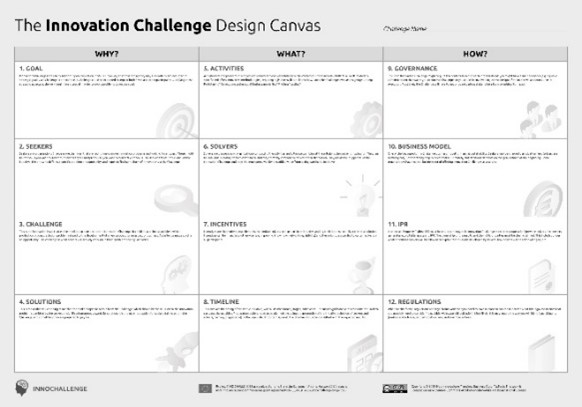
These are aligned with the priorities of the so-called S3 – Smart Specialization Strategy, developed by the region to guide investment in research, innovation, and economic growth. This know-how has been consolidated into tools—a design canvas and a visual guide—that can be used by innovation professionals to set up custom Innovation Contests
Feel free to download the “Innovation Challenge Design Canvas” at: www.innochallenge-project.eu
Outcomes
Since 2017, more than 120 companies and public administrations have participated in HIT’s Innovation Challenges. Companies report high satisfaction with the results (average score of 4.1 in a 1 to 5 scale). They particularly value the quality and robustness of the tangible outputs (prototypes), and even more so, the “less tangible” results related to companies innovation capacity, such as: increased awareness of the potential benefits of a technology; better understanding of the risks and possible roadblocks of a technology development project; networking with technology partners; talent scouting of young professionals; growing awareness of the benefits of open innovation and the need to improve how R&D and innovation is managed internally.
But what happens after these Challenges end? What do companies actually do with the outputs? Are prototypes developed and industrialized, or not? How often do these projects continue, and how frequently does the company effectively capture the innovation and the value it generates?
Since 2023, HIT has started measuring the impact of its thematic Innovation Challenges: companies are interviewed 18–24 months after the Challenge ends using a questionnaire that collects both quantitative and qualitative data. From the data gathered so far, it emerges that around 30% of participating companies mature or industrialize the Challenge outputs, integrating them into their products/processes/services. This percentage varies depending on whether the initial challenge focused on improving or incrementally innovating existing products/services/processes (which sees higher impact rates), versus developing entirely new ones (which sees lower rates)—a difference likely due to the risks involved in new projects and their longer time-to-market.
A particularly interesting data point: one in four companies that followed up on the Challenge results (about 8% of total participants) say they did so with researchers or professors they met during the Challenge. That percentage significantly raises to 22% when it comes to follow-ups involving students, who are often hired (either permanently or on project-based contracts), or engaged as thesis students or interns.
Nevertheless, about 50% of interviewed companies, although generally satisfied with the results, still have not been able to launch a follow-up project even after 18–24 months. The main reasons include lack of budget, lack of internal expertise, and lack of time. This is the area HIT plans to focus on next, launching dedicated follow-up programs aimed at further increasing the impact of its Innovation Challenges.
Festscrift to further understanding of Open Innovation
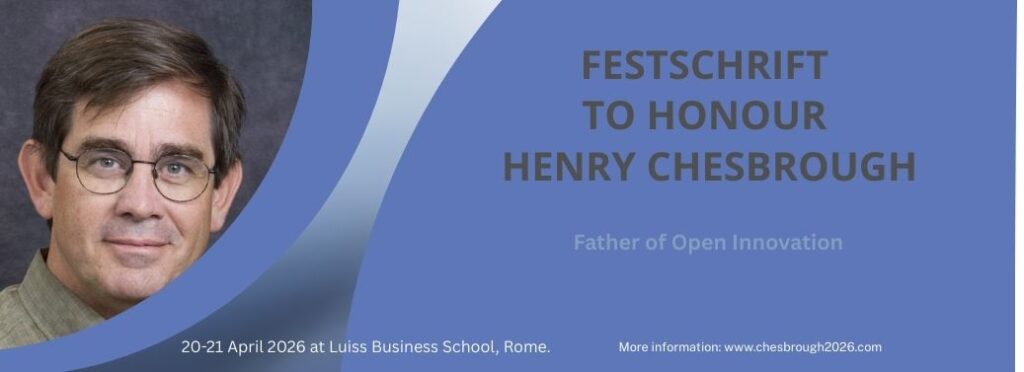
To honour Henry Chesbrough and his work in Open Innovation there is to be Festschrift in April 2026.
About Hub Innovazione Trentino (HIT)
HIT works in close contact with its shareholders (including the University of Trento and the Bruno Kessler Foundation, a top-level technology research centre focussing especially on ICT, AI, MEMS, and advanced materials) to carry out actions to exploit existing intellectual property assets (e.g. patents), as well as to support the initiation of new innovation projects between research and business (funded either by companies themselves or by national or European Commission grants). HIT also manages training programs on innovation and entrepreneurship for PhD students and researchers, and pre-incubation programs for startups/spin-offs.