Intrigued by annecdotal reports from former clients and associates about an increase in global organisations looking to restructure R&D operations in 2025, R&D management practitioner and technology strategist, Steve Bone decided to investigate the drivers for this trend.
His research revealed that measures directed at improving operational efficiency may infact pose a ‘significant risk of slowing innovation’ unless it has a clear strategic direction.
Steve explains: “In 2025 we saw comprehensive restructuring initiatives to consolidate resources around core business priorities, with reductions within R&D functions carefully targeted to achieve higher returns on investment, during a period of economic uncertainty. This has led to rationalisation within the areas of R&D considered ‘non-essential’.

“Businesses now face a delicate balance between achieving short-term financial efficiencies and preserving long-term innovation capacity. For anyone with a background in R&D management and innovation strategy, this moment feels less like transformation, and more like a reset — redefining what counts as “core” research and innovation.
“The companies we have spoken to are not prioritising innovations and growth, but focussed on survival.”
Steve argues that R&D is the oxygen of a company, and if restructuring is implemented with clear, strategic intent, it can extend well beyond short‑term defensive goals and generate significantly greater long‑term value for the business.
In this guest post he discusses the findings of his investigation and outlines the elements and benefits of using a structured framework for R&D restructuring.
2025 was the year of significant R&D reorganisation
Since the 2008 global financial crisis, the economic landscape has been defined by persistent disruption rather than traditional business cycles. This prolonged instability has placed sustained pressure on R&D functions.
By 2025, there was a tipping point for some organisations with these pressures culminating in widespread short‑term restructuring, often implemented without fully considering longer‑term innovation needs.
It appears that for many organisations, R&D reorganisations in 2025 have been driven by cost pressures, AI adoption, and US government policy shifts.
Although, a share of management attention has remained on large-scale, ‘upbeat and growth’ transformation programmes, much of the focus had shifted towards more pragmatic priorities centred on cost control and organisational survival.
This is evidenced by a review of the news. (See table below).
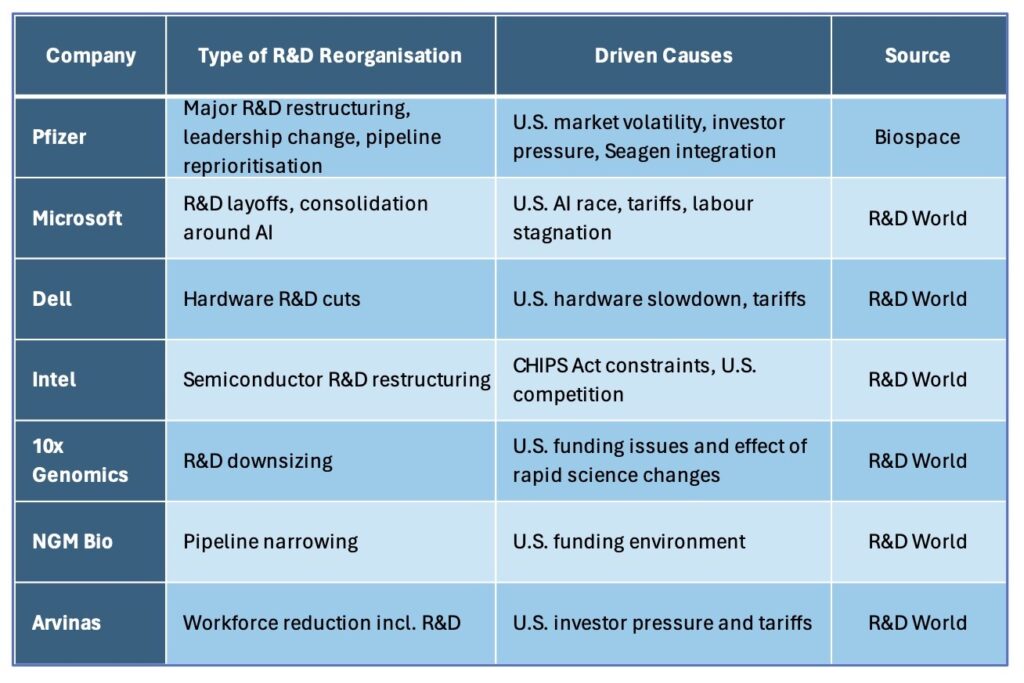
The reasons for R&D restructuring appear to be consistent across different technology sectors – reducing the scope of R&D, redirecting investment and redesigning roles to align with budget realities and the impact of AI.
Hardware and semiconductor companies R&D restructure driven by AI trends
Large hardware and semiconductor firms, including Dell, Microsoft, and Intel, have reduced R&D workforces as part of efforts to reorient research portfolios toward AI and adjacent emerging technologies.
Microsoft, has presented these changes as necessary to strengthen its competitive position in a fast-changing market.
Amazon pursued a similar logic, a global operational reorganisation in early 2025, removed thousands of managerial roles to redirect investment toward AWS, robotics, and automation-focused research.
Collectively, these actions reflect a broader strategic shift toward AI-led efficiency gains and long-term bets on clean-energy and advanced infrastructure.
Restructuring in the pharmaceutical and healthcare driven by pipeline optimisation
Industry survey evidence indicates that across the biopharmaceutical industry, senior executives are re-evaluating R&D strategies.
Many are choosing to reduce portfolio breadth, as a means of controlling costs, and redirecting investment toward areas with stronger innovation and growth potential, including advanced therapeutic platforms such as cell and gene therapies.
With traditional cost-cutting approaches – such as reductions in selling, general, and administrative (SG&A) expenses – largely exhausted, organisations have turned their attention to R&D and operational frameworks to achieve deeper, more sustainable saving.
For example, policies such as the U.S. Most-Favoured-Nation (MFN) drug pricing rule have forced companies like Pfizer to anticipate steep price reductions on key drugs.
Following its $43 billion acquisition of Seagen, Pfizer has implemented a significant reorganisation to streamline operations without workforce reductions. During 2025 it discontinued 11 research programmes as part of a $1.7 billion cost-saving initiative.
Approximately $500 million of these savings were directly attributable to R&D restructuring, aimed at enhancing productivity and embedding digital enablement and artificial intelligence into research workflows.
Rollback of federal science has impacted industrial research
2025 saw a sharp decline in federal support for scientific research.
This reflects a significant shift in U.S. science funding priorities, as shown in the graphic.
It’s too early to be specific but sources suggest that this equates to direct value impact (conservative) of $3 billion in foregone federal research activity. This equates to $4.5–6.3 billion in lost downstream economic value because basic research historically delivers high economic multipliers.
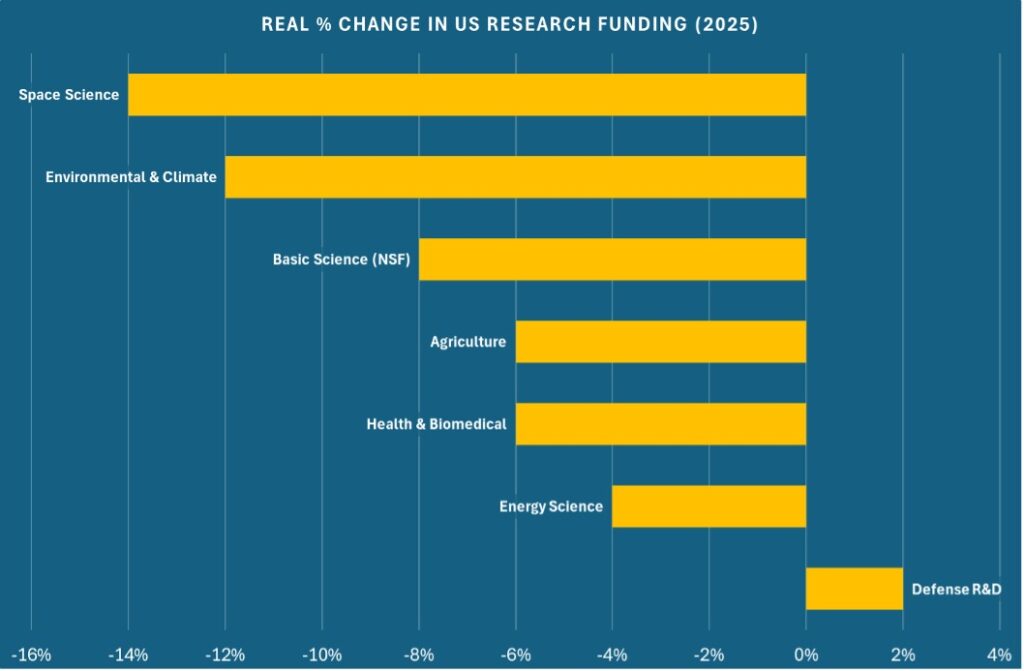
Above is a data‑focused summary of the rollback of US federal science in 2025, with quantitative figures, concrete policy actions, and agency‑level impacts.This is limited to what can be evidenced in 2025, not earlier trend data, and cited each point. This is based on an approximate averaging of many sources.
Academic job losses
Using only numbers reported by credible outlets and clearly labelled “assumptions” for universities, the plausible job lost in 2025 is about 6,500 to 13,700.
- Federal agencies & national labs (contractors): ~5,000 to 9,200 job losses
- Universities (net job losses tied to cancelled grants): ~1,500 to 4,500 job losses
These figures do not include the broader innovation, science and technology ecosystem including contractors. Or those selling scientific equipment, US R&D groups based overseas, and other universities outside the US. The toll could be substantially more.
More data will be available in the future.
Rising concern over long-term resilience of US STEM talent pipeline
Cuts to research funding has proved one of the most important drivers for R&D restructure in 2025.
The effects of the funding reductions extend well beyond individual mobility. They are placing pressure on university research capacity and weakening public–private collaboration. This is constraining industrial R&D activity both in the United States and across the global research ecosystem.
This is raising concerns about the long-term resilience of the U.S. STEM talent pipeline, as increasing numbers of highly skilled scientists and technologists consider opportunities in Europe and Canada.
A coalition of more than 100 biotech and life sciences chief executives have raised public concerns about proposed reductions in funding for the National Institutes of Health and the National Science Foundation.
They argue that sustained cuts would weaken the biomedical innovation ecosystem and force companies to reassess long-term R&D commitments, including investments in clinical development and early-stage research. According to the group, such changes could have lasting negative consequences.
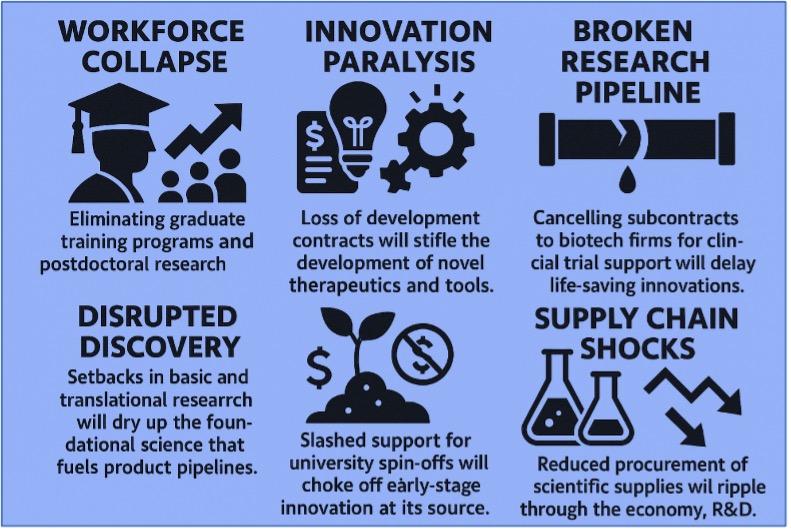
Global impact of U.S. policy on R&D supply chains
For decades, private companies and universities have collaborated on R&D on a global scale. However, this is changing, and the early signs are already visible in R&D supply chains, talent flows, and regional economies.
Trends include:
- Firms relocating R&D to Europe (Belgium, France) where governments are offering “academic asylum.”
- Brain drain – Canada, China, and Australia have launched recruitment programs aimed at U.S. scientists.
- A pivot from basic discovery to near‑term commercial projects.
The Conversation reports that NIH clinical trials were abruptly suspended, which directly affects Contract Research Organisations (CROs) that run federally funded studies, leading to:
- Downsizing of early‑phase research units.
- Shifting global trial operations to Europe and Asia.
- Consolidating vendor networks and closing US satellite labs.
- Offshoring future industrial R&D capacity, even if current spending appears stable.
Restructuring R&D to retain value
Global R&D management has adopted a number of strategies to create opportunity out of challenge:
- Decentralisation: this is expected to continue with more multi-hub models with centres in Asia, Europe, and North America.
- Portfolio Prioritisation: greater emphasis on late-stage, high-return projects, and applied research, while basic science may increasingly rely on philanthropic or international funding.
- Digital Integration: global teams will leverage AI-driven platforms for coordination and knowledge sharing to reduce costs and accelerate innovation..
Benefits of a strategic approach to R&D restructure
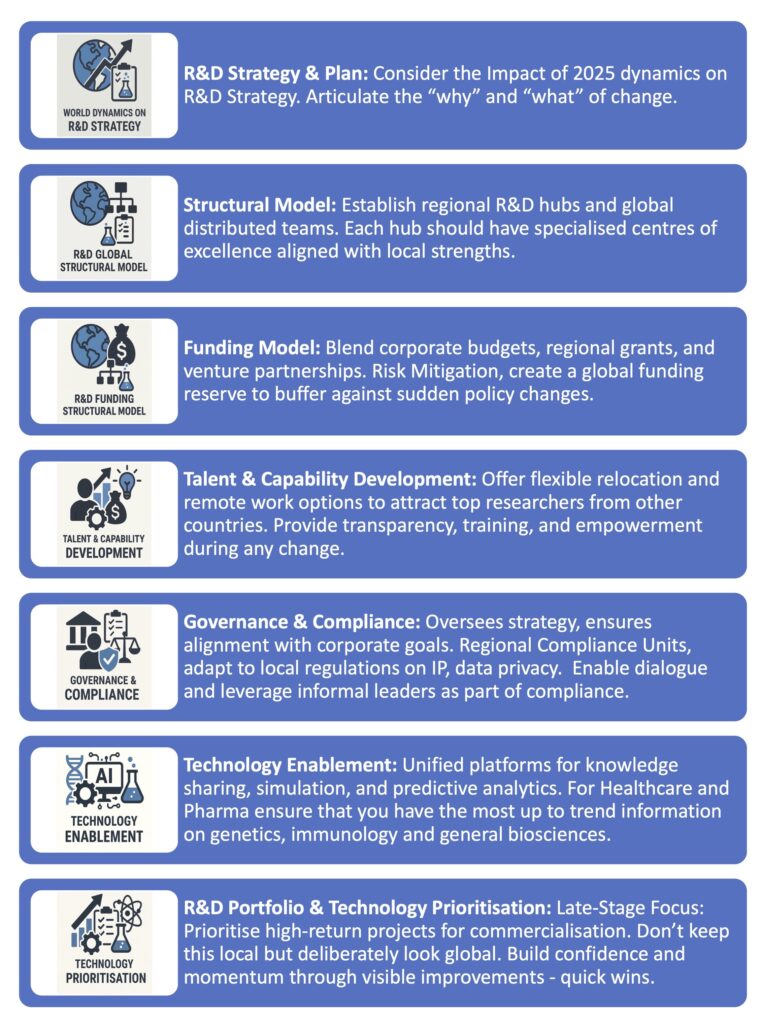
When a R&D restructure is conceived and implemented with clear, strategic intent (see graphic below), it’s benefit can extend well beyond short‑term defensive goals and generate significantly greater long‑term value for the business.
Benefits include:
- Better strategic value: It provides leadership with clearer visibility of the R&D portfolio, enabling informed trade‑offs between core innovation, differentiation, and longer‑term options. As a result, R&D spend is more tightly linked to value creation and growth objectives.
- Higher financial and commercial impact: A streamlined R&D structure increases productivity and improves cost transparency. Duplication is reduced, decision‑making is simplified, and ownership of outcomes is clearer.
- Better talent and organisational health: A clear structure, defined career paths and stronger technical communities support attraction and retention of critical talent. This builds a more resilient, future‑ready R&D organisation capable of sustaining innovation over the long term.
- Stronger governance and earlier risk identification: Reduces the likelihood of late‑stage failures, regulatory delays, or costly redesigns. This increases predictability of delivery and strengthens confidence in R&D‑led commitments.
- Higher innovation quality and risk reduction: By organising around common platforms, standards and technology roadmaps, the reorganisation improves technical consistency and reduces dependency on individuals and local practices.
- Faster speed, agility and execution: The reorganisation shortens development cycles by clarifying accountability, improving cross‑functional integration, and simplifying governance. End‑to‑end ownership of products or platforms enables faster responses to customer needs, regulatory changes, and competitive pressure.
- Scalability and future readiness: The reorganised model improves the company’s ability to scale R&D up or down, integrate acquisitions, and introduce new capabilities as strategy evolves. It reduces the need for repeated structural change, lowering future disruption and cost.
Example of a best-practice framework for a structured approach to R&D
In conclusion
Given the realities of current geopolitical instability, accelerating technology cycles, and intensifying competitive pressure, a well designed R&D strategy should look beyond the short-term challenges.
A best‑practice framework that consistently converts R&D capabilities into new products, processes, and market opportunities will support sustained growth and enhance innovation capability.
Background reading
2025 R&D layoffs tracker: hardware and chips lead the year’s biggest cuts while biopharma pares pipelines, Brian Buntz, October 3, 2025. R&D World.
2025 R&D Layoffs: Navigating Workforce Cuts Amidst Growth Trends, https://opentools.ai/news/2025-randd-layoffs-navigating-workforce-cuts-amidst-growth-trends#section5
Breakthroughs in AI-augmented R&D: Recap from the 2025 R&D Leaders Forum, September 22, 2025. At McKinsey’s second annual R&D Leaders Forum, more than 50 senior executives in innovation, R&D, and engineering convened to explore how AI is reshaping the future of product development and scientific research. https://www.mckinsey.com/capabilities/operations/our-insights/operations-blog/breakthroughs-in-ai-augmented-r-and-d-recap-from-the-2025-r-and-d-leaders-forum?utm_source=copilot.com
6 Predictions: How AI Will Transform Scientific R&D In The Next Decade, Michael Connell, Jun 30, 2025. Forbes. https://www.forbes.com/councils/forbestechcouncil/2025/06/30/6-predictions-how-ai-will-transform-scientific-rd-in-the-next-decade/?utm_source=copilot.com
Performance improvement in pharmaceuticals operations, “A new playbook for pharma”, Thilo Kaltenbach and Stephan Fath, July 30, 2025, Roland Berger GmbH. https://www.rolandberger.com/en/Insights/Publications/Performance-improvement-in-pharmaceuticals-operations.html
Pfizer’s MFN Crossroads: Can Cost Cuts and Innovation Secure Its Pharma Leadership, Rhys Northwood, Jun 12, 2025, Ainvest News. https://www.ainvest.com/news/pfizer-mfn-crossroads-cost-cuts-innovation-secure-pharma-leadership-2506/
Pfizer Cuts 11 R&D Programs amid Ongoing Revenue Declines and Cost Realignment Efforts, Talk Bio 2025, https://talk.bio/2025/11/05/pfizer-cuts-11-rd-programs-amid-ongoing-revenue-declines-and-cost-realignment-efforts/
Pharma: From AI and layoffs to supply chains and political unknowns, Deloitte outlines key areas for biopharma to watch in 2025, By Fraiser Kansteiner Dec 26, 2025. https://www.fiercepharma.com/pharma/ai-and-layoffs-supply-chains-and-customer-engagement-deloitte-outlines-key-areas-biopharma
Science under siege: Trump cuts threaten to undermine decades of research, By Evan Bush, Aria Bendix and Denise Chow, NBC News, February 2025. https://www.nbcnews.com/science/science-news/trumps-nih-budget-cuts-threaten-research-stirring-panic-rcna191744
Key Sources for data‑focused summary of the rollback of US federal science figure: AAAS R&D Budget and Policy Program (2025 analysis), Congressional Research Service (CRS), Office of Management and Budget (OMB) and NSF, NIH, DOE, EPA, NASA FY2025 Budget Justifications. Many quotes from academia and industrial science and R&D Managers in many references.
The economic effects of federal cuts to US science — in 24 graphs, Is US science facing a recession? Growing evidence points to a looming downturn, 5 June 2025, Nature. https://www.nature.com/articles/d41586-025-01830-5?utm_source=copilot.com
Attacks on research and development could hamper technological innovation, Nicol Turner Lee and Josie Stewart, June 23, 2025. https://www.brookings.edu/articles/attacks-on-research-and-development-could-hamper-technological-innovation/ (Nicol Turner Lee is a senior fellow in Governance Studies, the director of the Centre for Technology Innovation (CTI), and serves as co-editor-in-chief of the TechTank blog and The TechTank Podcast).
Biomedical Leaders Warn of ‘Catastrophic’ Fallout from Trump-Vance Research Cuts, Global Biodefence, July 3, 2025. https://globalbiodefense.com/2025/07/03/trump-vance-research-cuts-biotech-warning-2025/?utm_source=chatgpt.com
This year nearly broke me as a scientist’ – US researchers reflect on how 2025’s science cuts have changed their lives, December 18, 2025, The Conversation, Carrie McDonough, Carnegie Mellon University, Brian G. Henning, Gonzaga University, Cara Poland, Michigan State University, Nathaniel M. Tran, University of Illinois Chicago, Rachael Sirianni, UMass Chan Medical School, Stephanie J. Nawyn, Michigan State University. https://theconversation.com/this-year-nearly-broke-me-as-a-scientist-us-researchers-reflect-on-how-2025s-science-cuts-have-changed-their-lives-271282?utm_source=copilot.com
EU announces €500 million package to woo scientists away from Trump’s America, France24, 5th May 2025. https://www.france24.com/en/europe/20250505-france-eu-us-scientists
As American Science Faces Cuts, Other Countries See an Opportunity, June 27, 2025. Association of American Universities. https://www.aau.edu/newsroom/leading-research-universities-report/american-science-faces-cuts-other-countries-see
Bridging the innovation gap: the UK’s R&D strengths and shortfalls, The UK’s new Modern Industrial Strategy, unveiled in June 2025, puts long-term research and development (R&D) funding at the heart of national growth. By pairing sustained public investment with incentives for private innovation, it aims to strengthen the country’s position in science, technology, and commercialisation, Dr Michele Palladino, September 29th 2025, Cambridge Industrial Innovation Policy. https://www.ciip.group.cam.ac.uk/reports-and-articles/bridging-the-innovation-gap/
7 Major Trends Shaping the Engineering and Research Industry: Insights for Investors, Consultants and Marketing Professionals in 2025, Plunkett Research Online data, 7th Oct 2025. https://www.plunkettresearch.com/7-major-trends-shaping-the-engineering-and-research-industry-insights-for-investors-consultants-and-marketing-professionals-in-2025/
How to Build a Successful R&D Strategy for Business, August 8, 2025, Slate Prism. https://slate.greyb.com/blog/research-and-development-strategy/
Political uncertainty can lead to growth and innovation, study finds March 4 2025, by Sheri Irwin Gish, https://phys.org/news/2025-03-political-uncertainty-growth.html#google_vignette
Parts of frameworks spanning over 20 years taken from publicly available information from Deloitte, McKinsey, Arthur D Little and nu Angle. This has been added to and modified over the last 3 years by SPB Associates.
The Role of R&D in Business, Innovation Through Research and Development. Signals and Communication Technology. Springer, 12 June 2024. https://doi.org/10.1007/978-3-031-52565-0_2
R&D Strategy: Building a Blueprint for Impactful Innovation, Samuel Medley, Aug 22nd, 2025, Qmarkets. https://www.qmarkets.net/resources/article/rd-strategy/
The present-focused, future ready R&D organization, There’s no one right way to organize R&D, by Anne Hidma, Sebastian Küchler, and Vendla Sandström. McKinsey, 2020. https://www.mckinsey.com/~/media/McKinsey/Business%20Functions/Operations/Our%20Insights/The%20present%20focused%20future%20ready%20RD%20organization/the-present-focused-future-ready-rnd-organization.pdf