Tim Brown of IDEO defines design thinking a discipline that uses the designer’s sensibility and methods, to match people’s needs with what is technologically feasible, and what a viable business strategy can convert into customer value and market opportunity.
There’s no single definition for design thinking. It’s an idea, a strategy, a method, and a way of seeing the world. For IDEO, design thinking is a way to solve problems through creativity.
As business leaders look to innovation as a source of differentiation and competitive advantage, Tim argues that they should be incorporating design thinking into all phases of the process.

A systems approach to disruptive innovation
In an article for Harvard Review he credits Thomas Edison as the first to adopt ‘design thinking’. When Edison invented the lightbulb, he understood that without electricity generation and transmission it would remain a parlour trick. So, he conceived a fully developed marketplace to ensure adoption of the disruptive technology.
Additionally, he created a team-based approach to innovation, that aimed not to validate preconceived hypothesis but to help the experimenters to learn something new. Design thinking is a development of these ideas.
Human-centred design ethos requires a deep understanding of what people want and need in their lives and what they like and dislike about products are made, packaged, marketed and sold.
How design thinking happens
According to IDEO, to think like a designer requires dreaming up wild ideas, taking time to tinker and test, and being willing to fail early and often.
The designer’s mindset embraces empathy, optimism, iteration, creativity, and ambiguity. And most critically, design thinking keeps people at the center of every process.
A human-centered designer knows that as long as you stay focused on the people you’re designing for—and listen to them directly—you can arrive at optimal solutions that meet their needs.
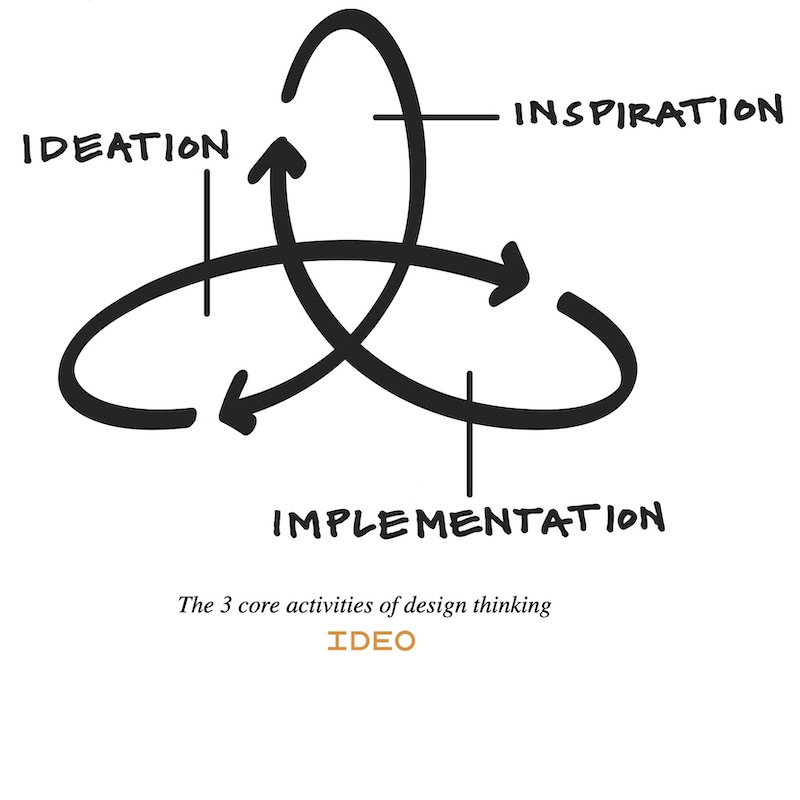
Core activities of design thinking
Tim says that conceptually design thinking consists of three spaces:
Inspiration – the problem/opportunity that motivates the search for solutions
Ideation – process of generating, developing, and testing ideas
Implementation – charting the path to market.
Design thinking provides low cost solution for nurses
Design thinking is not limited to products, it can also be used to redesign services. Tim gives this example of improving shift handovers by nurses.
Inspiration: It was taking nurses 45 minutes to provide a debrief on the status of patients and many important factors were being missed.
Ideation: Following observation, brainstorming, and prototyping, the team of designers, specialists and nurses – developed some easy-to-use software that captured events.
They also changed the process by moving the debrief to the patient’s bedside.This enabled more effective communication with the patient, reducing stress for them and their family.
Using the software to record events as they happened and involving the patient in the debrief reduced the time required for the handover and ensured more comprehensive collation of information. This was a small process innovation that delivered outsize impact.
Implementation: Following the success of this pilot, the human-centric design approach was adopted more widely across the organisation, so that every doctor, nurse, and administrator at the hospital felt empowered to tackle problems.
Integrating design thinking into innovation process
Tim recommends an eight-step process:
- Involve design thinkers at the very start of the innovation – this will enable more ideas to be explored more quickly
- Use a human-centric approach – direct observation can offer unexpected insights and capture more precisely what consumers want.
- Rapid experimentation and prototyping – measure progress through time to first prototype, number of consumers exposed to prototypes.
- Co-create with customers and consumers – enlarge the scale of your innovation team.
- Initiate revolutionary innovation from the top – expect business teams to fund and drive incremental innovation but be prepared to fund more disruptive innovation.
- Adjust budget to pace of innovation – don’t constrain innovation through cumbersome budgeting cycles.
- Diversify talent recruitment – interdisciplinary programs train designers that can push beyond expectations.
- Experience the full cycle – plan so design thinkers see the project through from inspiration, ideation, and implementation.
Case study – transforming sick days with play
Playhouse MD co-founders are sisters Sydney and Kaitlin Wiseman. Kaitlin, a family practice doctor specializing in childcare and a mother of two, tried to make office checkups less scary for young patients by attaching toys designed by her sister, Sydney, to her otoscope (a device used to check inside kids’ ears).
Her lighthearted approach worked, putting both kids and parents at ease. Armed with a solid proof-of-concept idea, Playhouse MD approached IDEO Play Lab with a two-part challenge: create a playful pediatric visit experience for children, parents, and healthcare practitioners through thoughtful accessories, and extend this joyful experience into care moments at home.
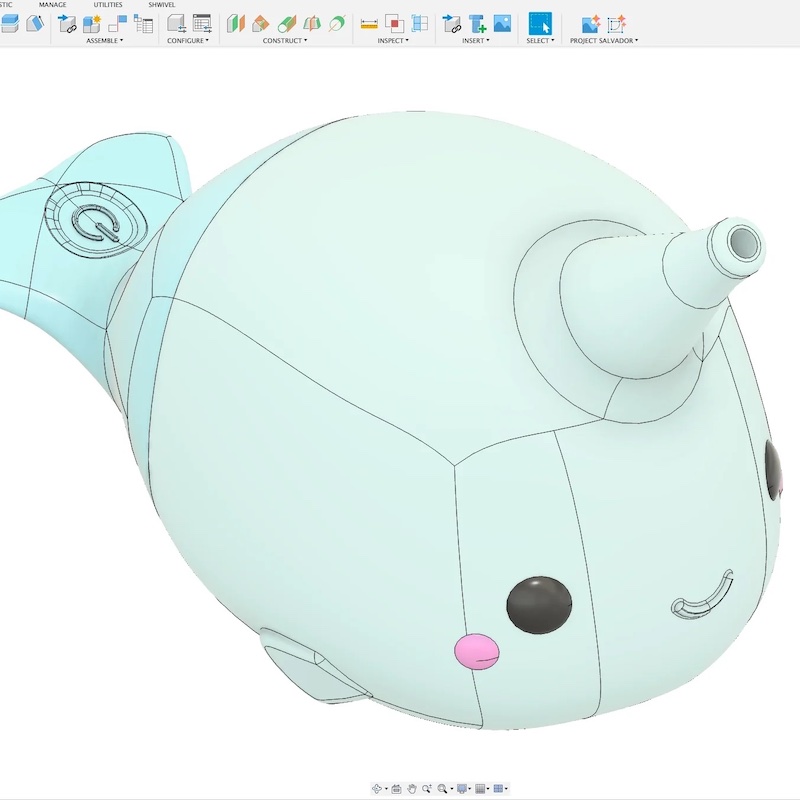
Inspired by this kid-centric formula, the IDEO Play Lab team winnowed down more than 150 brainstorm ideas into a dozen tangible prototypes (or tinker models) that were shown to doctors, nurses, parents, and young kids for feedback. The designs—a rocket ship medicine dispenser, an elephant-shaped nose aspirator, and a narwhal nasal bulb, among others—were intended to evoke a sense of playfulness, comfort, and familiarity, with features designed for maximum cuteness. Some even lit up and played sounds, like popular toys.
Playhouse MD began selling its first four direct-to-consumer products on its website in June 2025: two Medicine Buddies (medicine dispensers shaped like a rocket ship and a butterfly) and two Booger Buddies (a light-up nasal aspirator elephant called Luna and a light-up nasal bulb narwhal named Noa, which was named one of The Best Inventions of 2025 by TIME).
Explore for yourself
IDEO provides free resources including the design kit which provides easy-to-use tools for each for the three spaces.
To read the full paper in Harvard Business Review.